Can You Sell Your Raleigh Home Without Being at Closing? NC Remote Closing Options for 2026
It’s not uncommon for me to work with sellers who have accepted an offer, are mid-move to another city, and realize that traveling back to Raleigh for closing is going to be a logistical nightmare. It is one of the most stressful moments in a transaction that should feel like a victory lap.
The good news for my clients and all sellers is that closing remotely in North Carolina is relatively simple and several different options area available to us. The state has strong legal infrastructure for it, and closing attorneys in the Triangle handle remote sellers regularly. What trips people up is not knowing which option to use, waiting too long to ask, or assuming the closing attorney will just handle it without a direct conversation.
Here is how each option works and what you need to do.
Option 1: Remote Online Notarization (RON)
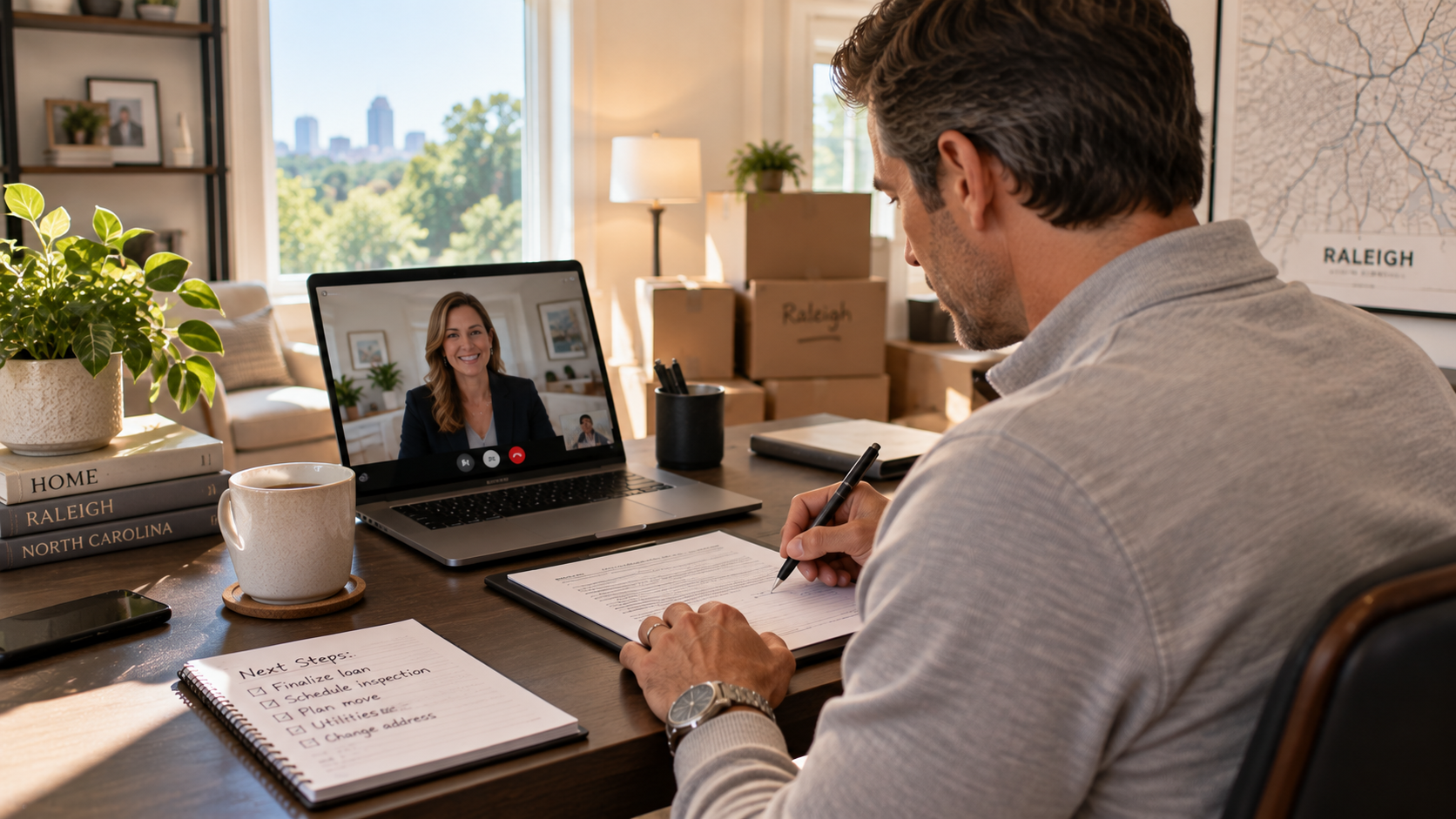
Remote Online Notarization allows you to sign your closing documents over a live, two-way video call with a RON-certified notary, from anywhere in the world with a reliable internet connection. North Carolina permanently authorized RON under G.S. 10B-134.1, and updated administrative rules took effect July 1, 2025, raising the bar for approved platforms and identity verification protocols.
I have not personally had a client to use this option at the time I wrote this blog post.
In a RON closing, you will:
- Connect via a state-approved video platform (your closing attorney or title company will provide the link)
- Verify your identity through knowledge-based authentication questions and government ID upload
- Sign documents electronically while the notary witnesses in real time
- Receive a fully executed, legally valid deed recorded with the county Register of Deeds
The practical catch: Not every closing attorney in North Carolina is set up for RON. This is changing fast, but you need to ask your attorney early in the process, ideally before or right after the contract goes binding. If your attorney is not RON-capable, they can often refer you to a firm that is, or coordinate with a RON-enabled closing service.
RON works especially well for: Sellers who have already relocated out of state, sellers who travel frequently for work, and any situation where being in Raleigh on a specific date is genuinely difficult.
Option 2: Power of Attorney (POA)
A Power of Attorney authorizes someone you trust to sign closing documents on your behalf in North Carolina. The appointed person, called your attorney-in-fact, appears at closing, signs the deed and all seller documents, and the transaction proceeds as if you were there.
I have several clients that opt for this closing option each and every year.
NC-specific requirements for a valid real estate POA:
- Must comply with the NC Uniform Power of Attorney Act (Chapter 32C)
- Must explicitly grant authority to convey real property and sign deeds
- Must be signed and notarized before a commissioned NC notary (or, in some cases, a notary in your current state)
- Must be recorded with the county Register of Deeds before or at closing — this is the step sellers most often miss
In July 2026, NC REALTORS® released an updated Limited Power of Attorney for Real Property Transactions form designed specifically for real estate closings. If your attorney or agent references this form, it is written to satisfy the recording and specificity requirements most lenders require.
Who can serve as your attorney-in-fact: A trusted family member, a close friend, or in some cases your real estate agent (with proper disclosure and your attorney’s guidance). Choose someone organized, available on the closing date, and who will not panic under paperwork pressure.
The practical catch: Your lender must approve the POA before closing if there is a mortgage payoff or if you are in a situation where lender authorization is involved. Give yourself at least 10 to 14 days to execute and record the POA before closing. Rushing this at the last minute is how deals get delayed.
Option 3: Mail-Away Closing Package
The third option is the most traditional. Your closing attorney sends you a physical package of documents, you take them to a licensed notary in your current city, sign in front of the notary, and overnight everything back before the closing date.
This is another common solution tthat many of my seller clients have implemented over the years.
This option works in almost every situation because it requires nothing special on the attorney’s side. It does require:
- A reliable overnight courier (FedEx or UPS)
- A licensed notary in your city (banks, UPS stores, and dedicated notary services all work)
- At least a 3 to 5 day window before closing for the documents to travel both ways safely
- Coordinated wiring of your proceeds to your bank account
Many sellers use the mail-away route simply because it is the most universally available option. It is slower than RON and less elegant than a POA, but it gets the job done.
How Your Proceeds Get to You
One thing sellers sometimes forget: when you close remotely, your net proceeds do not arrive by check. Under the NC Good Funds Settlement Act (G.S. Chapter 45A), proceeds are wired after the deed is recorded with the county Register of Deeds. Your closing attorney will send a wire to the bank account you designate before closing.
Before your closing date, make sure you:
- Provide your bank’s ABA routing number and your account number in writing to the closing attorney
- Verify the wire instructions directly with the attorney (not via email alone, to protect against wire fraud)
- Confirm the expected recording time, which is typically the same day as closing in North Carolina
Proceeds usually arrive within a few hours of recording. In some counties, same-day recording is guaranteed; in others it can extend to the next business day if closing happens late in the afternoon.
What to Have Ready Before Your Remote Closing
Regardless of which method you use, you will need the following ready well before your closing date:
- A valid government-issued photo ID (driver’s license or passport — your attorney will specify which)
- Your mortgage payoff information (your attorney handles this, but confirm your lender has been notified)
- Forwarding address for any remaining mail or documents
- Bank account details for your wire transfer
- Homeowners insurance cancellation or transfer timing (coordinate with your insurance agent)
Your real estate agent and closing attorney should be walking you through this checklist. If they are not, ask directly. You should have a clear written timeline of what needs to happen and when at least two weeks before your scheduled closing date.
Start the Conversation Early
The biggest mistake remote sellers make is waiting until the week before closing to bring this up. RON needs platform setup and attorney coordination. A POA needs to be drafted, notarized, and recorded. A mail-away package needs a multi-day shipping window on both ends.
If you need to take advantage of any of these closing options, you need to bring it up as soon as you go under contract. Tell your agent you will be closing remotely and ask them to flag it immediately with the closing attorney. Any experienced Triangle listing agent has navigated this situation many times, and a good one will get everything moving before it becomes a logistical fire drill.
The how long it takes to sell a house in Raleigh NC post walks through the full seller timeline from list to close, so you can see exactly when the closing attorney steps in and how much runway you have. For sellers who have already listed or are thinking about listing while managing a relocation, the post on what to expect at closing as a seller in Raleigh NC covers the full closing day process, including the pre-signing option many remote sellers use. If you are still in the early planning stages and have not yet listed, reading through what sellers need to know before signing the NC listing agreement will help you understand your timeline and commitments from the start. And for anyone managing a simultaneous purchase out of state, the guide to how to choose a listing agent in Raleigh NC covers the questions worth asking before you sign any listing paperwork.
Frequently Asked Questions
Can I sell my NC home via RON from another country?
Yes, provided you have a reliable internet connection and meet the identity verification requirements on the state-approved RON platform. North Carolina’s RON law (G.S. 10B-134.1) does not restrict the seller’s physical location, only the notary’s compliance with state-approved platform and verification standards. Sellers closing from abroad may also need to complete additional identity verification steps, so coordinate with your closing attorney well in advance.
Does my lender need to approve a Power of Attorney for closing?
Yes, in most cases. If your sale involves paying off an existing mortgage, your lender must review and approve the POA before closing. This approval process can take 5 to 10 business days, which is why executing the POA early matters. Give your closing attorney the POA draft as soon as possible so they can submit it to the lender without creating a last-minute delay.
What if my closing attorney is not set up for RON?
Ask your closing attorney to refer you to a RON-capable firm, or ask your real estate agent to recommend one. In the Triangle market, RON adoption among real estate closing attorneys has grown significantly since the July 2025 rule updates. Your agent should know which firms are equipped for it. Alternatively, switch to the POA or mail-away option, both of which require no special setup on the attorney’s side.
How long does a remote NC closing take compared to an in-person closing?
A RON closing typically takes 30 to 60 minutes once you are connected, comparable to an in-person signing session. A mail-away closing takes longer from a logistics standpoint (documents must travel to you, be signed and notarized, and travel back), but the actual signing time is the same. A POA closing happens in your attorney’s office without you, so from your perspective it is almost invisible once everything is set up.
Will my proceeds arrive the same day as closing?
In most cases, yes, for closings that happen before noon. Under the NC Good Funds Settlement Act, proceeds are wired after the deed records. Wake County records deeds the same day in almost all cases. If your closing is scheduled late in the afternoon, the recording and wire may push to the next business day. Confirm the exact timing with your closing attorney in the week before closing.
Selling your Raleigh home remotely is not complicated once you know the options and plan accordingly. The sellers who run into problems are almost always the ones who mentioned it for the first time the week before closing.
If you are preparing for a remote sale or trying to figure out how to manage a relocation alongside a Triangle transaction, I am happy to walk through your specific situation and make sure everything is lined up well before the closing date. Email me at brandon@theoceanairerealty.com or call or text 910-228-6481 anytime.
About Brandon Yopp
Brandon Yopp is a top-producing REALTOR® with The Oceanaire Realty, serving sellers and buyers across Raleigh, Durham, Chapel Hill, Cary, Apex, and the surrounding Triangle communities in North Carolina. A Triangle resident for more than 20 years, Brandon is known for deep local market knowledge, strategic pricing, expert negotiation, and a marketing approach built to give sellers maximum exposure across the platforms today’s buyers actually use. He’s a multi-year Triangle Real Producers Top 500 honoree and a Certified Luxury Home Marketing Specialist™, guiding first-time buyers, upsizers, downsizers, relocating clients, and investors through the Triangle market with confidence. Over 90% of his business comes from repeat clients and referrals.