Townhouse vs. Single-Family Home in Raleigh, NC: Which Is the Better Buy in 2026?
This is one of the most common conversations I have with first time buyers who are serious about purchasing in the Triangle but haven’t landed on a property type yet. The math looks obvious at first — the townhouse costs less, so maybe start there. But it’s more nuanced than the price tag.
Here’s a full comparison so you can make the right call for your situation.
The Price Gap: What You’re Actually Getting for the Difference
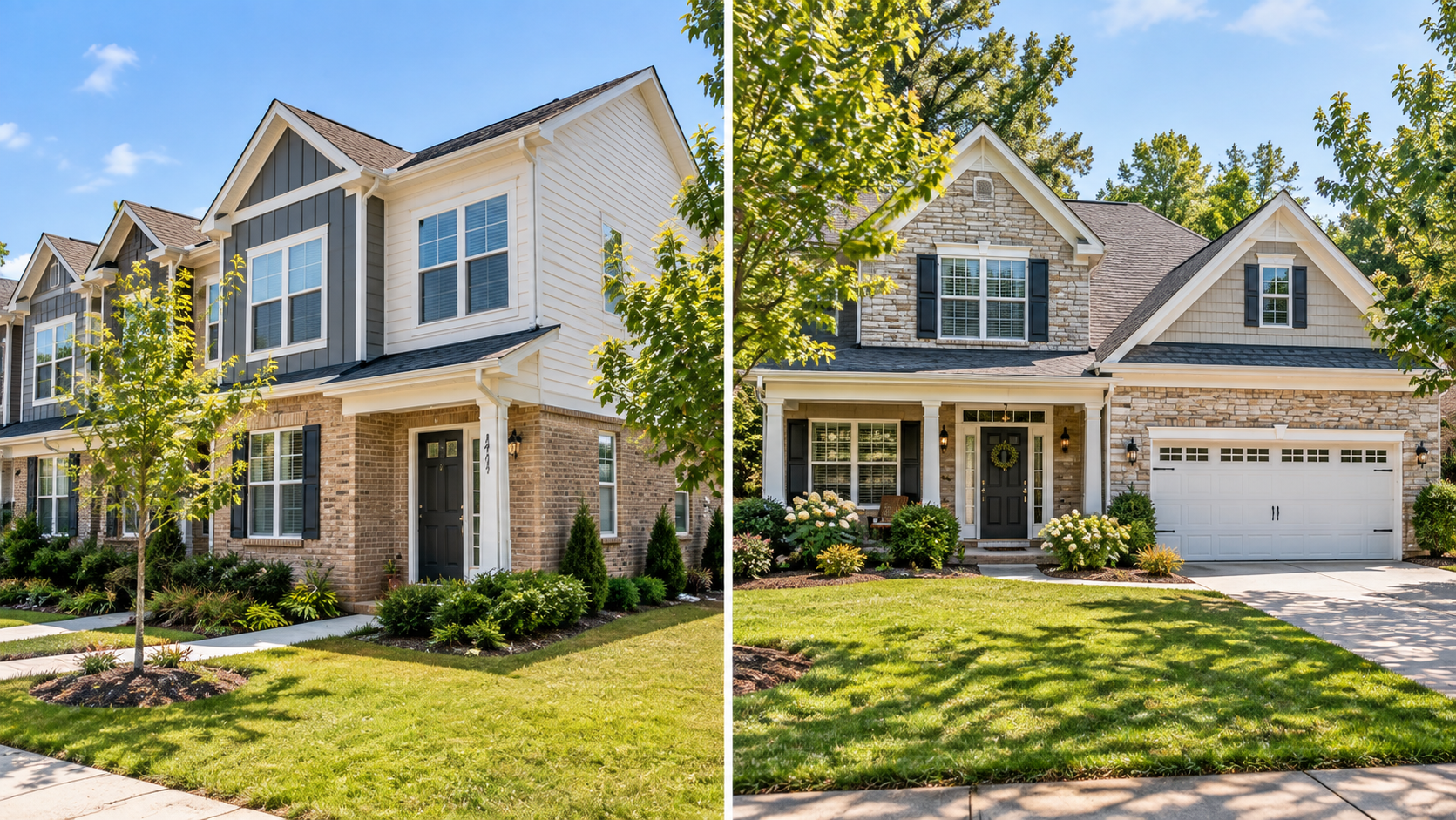
The price gap between townhouses and single-family homes in Raleigh is real and significant. In March 2026, Axios Raleigh reported that the median townhome in the area was selling for $336,995 versus $469,945 for a single-family home — a difference of about $133,000.
That gap matters differently depending on where you’re financing. On a $337,000 townhouse with 10% down, you’re financing $303,000. On a $470,000 single-family home with 10% down, you’re financing $423,000. At a 6.5% rate over 30 years, that’s roughly $500 to $600 per month more for the single-family — before insurance, taxes, and HOA.
But the townhouse comes with HOA dues. In the Triangle, townhome HOA fees typically run $150 to $450 per month, depending on community amenities and what the association covers. Most townhome HOAs cover exterior building maintenance (roofing, siding, gutters), landscaping of common areas, and sometimes water and trash. Some higher-end communities include pools, fitness centers, and exterior pest control.
That $150 to $450 in monthly HOA dues closes some of the payment gap between property types. When you factor in maintenance costs that the HOA covers (things a single-family homeowner pays out of pocket), the total cost picture gets closer than the purchase price difference suggests.
What You Get With a Townhouse
Lower entry price. In a market where the single-family median in Wake County hit $440,000 in July 2026, townhouses give buyers a meaningful entry point that’s often $100,000 to $150,000 lower. For a first-time buyer, that difference can mean the gap between buying now versus waiting another two to three years.
Less exterior maintenance. The HOA handles roofing, gutters, siding, exterior painting, and landscaping in most townhome communities. You own from the interior walls in, which is a significantly smaller maintenance surface. No landscaping hours, no roof replacement surprise, no power washing falls on the owner in most townhome communities.
Location access. Townhomes tend to be built in denser, often more walkable locations. In the Triangle, strong townhome inventory exists close to North Hills, Brier Creek, downtown Cary, Morrisville, and Apex — areas where single-family homes at comparable prices are much harder to find.
Shared walls. This is the main trade-off. You share at least one wall (often two) with neighbors. Noise transmission varies widely by construction quality and year built. Newer construction townhomes in Cary and Apex tend to have better insulation than older stock.
HOA restrictions. Rental policies, pet rules, exterior modification restrictions, and parking requirements are governed by the HOA. If you’re buying as an investment with plans to rent, review the rental policy before you make an offer. Some communities cap the percentage of units that can be rented at any time. An increasing amount of Raleigh area communities have very strict rental policies that are seriously enforced and monitored.
What You Get With a Single-Family Home
Land ownership. You own the lot. That’s the foundational difference — and it’s what typically drives higher long-term appreciation. Land becomes more valuable as the Triangle grows, and single-family homeowners capture that directly.
Privacy. No shared walls. You can play music, have a dog that barks, let the kids run inside, and renovate without a neighbor three feet away. That privacy premium is real and hard to quantify until you’ve lived in a townhome.
Flexibility. Want to build a deck, add a fence, paint the front door navy blue, or put in a pool? Single-family ownership — especially in communities with minimal HOA restrictions — gives you substantially more control over the property.
More storage. Garages, attics, and detached structures are much more common with single-family homes. If you own tools, sports equipment, holiday decorations, or run any kind of small business from home, square footage and storage matter.
Potentially higher appreciation. Over the long run in the Triangle, single-family homes have appreciated at higher rates than attached properties. This isn’t guaranteed going forward, but the land component gives single-family homes a structural advantage that townhomes — even well-located ones — can’t fully replicate.
How to Choose: The Right Questions to Ask Yourself
How long do you plan to stay? If you’re buying for a handful of years, a townhouse in a high-demand submarket like North Raleigh or Cary can make strong financial sense. If you’re planting roots for seven to ten years or more, the appreciation upside of a single-family home is harder to ignore.
How do you feel about HOA governance? HOA communities have rules. Some buyers find the maintenance relief worth every restriction. Others find the bylaws, dues increases, and board politics more frustrating than they anticipated. Read the full HOA documents — financials, reserves, meeting minutes — before you commit.
What’s your maintenance tolerance? If you travel frequently, work long hours, or simply don’t want to deal with exterior upkeep, a townhouse HOA that handles it for you has real value. If you like controlling your own maintenance timeline and contractors, single-family gives you that.
What’s your budget for monthly costs, not just purchase price? Run the full monthly number for both scenarios: mortgage payment + HOA (townhouse) versus mortgage payment + estimated maintenance reserve (typically 1% of purchase price per year for single-family, set aside monthly). The comparison is tighter than the list price gap implies.
For either property type, the first step is the same: understanding what buying costs look like in the Triangle. My guide to buyer closing costs in the Triangle breaks down what you’ll pay at the closing table regardless of property type.
Triangle Submarkets: Where Townhouses and Single-Family Homes Compete
In the Triangle, certain areas skew heavily toward one type. Knowing the market by submarket helps you target your search.
Townhouse-dominant areas: Brier Creek, Morrisville, Durham (especially near Research Triangle Park), downtown Cary, West Cary (Fenton area), Apex (near downtown), and parts of South Raleigh near 540.
Single-family dominant areas: North Raleigh (Wake Forest Road corridor, Falls Lake communities), North Hills, Inside The Beltline, Cary (established neighborhoods like MacGregor Downs, Lochmere), Chapel Hill and Carrboro, Durham (Hope Valley, Forest Hills), and most suburban communities in Holly Springs, Fuquay-Varina, and Knightdale.
Many buyers in the Triangle find themselves comparing these two types side by side. My guide on buying a home in Raleigh NC for the first time covers both, and if you’re also weighing new construction, my new construction vs. resale guide is worth reading — because a significant portion of Triangle townhouse inventory is new construction.
What the HOA Due Diligence Looks Like
Before you write an offer on a townhouse, understand what you’re buying into from an HOA standpoint. Under NC G.S. Chapter 47F (the NC Planned Community Act), sellers of HOA-governed townhomes must provide a resale package including current bylaws and rules, the annual budget, financial statements, current dues and pending assessments, and the reserve fund balance.
The key things to look for: is the HOA financially healthy (reserve fund funded at 70% or more of recommended level is generally solid), are there any pending special assessments, and are there active lawsuits against the association? A well-run HOA is an asset. A struggling one is a liability you’ll inherit.
Frequently Asked Questions
Do townhouses appreciate as much as single-family homes in Raleigh NC?
Generally, single-family homes in the Triangle have appreciated at higher rates over the long term because of the land component. However, well-located townhomes in high-demand submarkets like North Hills, Cary, and Apex have performed very well. Appreciation depends heavily on location, community quality, and timing — no property type comes with a guarantee.
Do I need a buyer’s agent to buy a townhouse in NC?
You have the option to tour properties without signing a buyer agency agreement in NC (using a Property Showing Agreement), but for making an offer and navigating the full transaction, working with a buyer’s agent is in your interest. The contract (NC Form 2-T), HOA due diligence, and negotiation process are the same whether you’re buying a townhouse or a single-family home.
Can I rent out a townhouse I buy in Raleigh NC?
It depends on the HOA. Some townhome communities in the Triangle allow rentals with no restrictions. Others cap the total percentage of rental units, require owner-occupancy for a set period after purchase, or prohibit short-term rentals entirely. Always request and read the rental policy before closing if renting is part of your plan.
Are townhouses harder to finance than single-family homes?
Not significantly for most buyers. Conventional, FHA, and VA loans all work for townhouses. Condominiums (which are legally distinct from townhouses) face additional FHA approval requirements — but a standard attached townhouse with its own land conveyance does not. Your lender can confirm the financing treatment based on the specific property.
What’s the typical HOA fee for a townhouse in Raleigh NC?
In 2026, most Triangle townhome HOA dues fall in the $150 to $450 per month range, depending on location, amenities, and what the association covers. Communities with pools, fitness centers, or significant common area maintenance run higher. Always verify the current dues and any planned increases in the HOA documents before you commit.
The right answer between townhouse and single-family usually comes down to your timeline, lifestyle, and what you’re optimizing for. If you want to run through both scenarios with real numbers from the current Triangle market, I’m happy to help you compare specific properties and communities side by side.
Reach out for a confidential buyer consultation — email brandon@theoceanairerealty.com or text 910-228-6481 and let’s find a time to talk through your goals and what the market looks like right now.
About Brandon Yopp
Brandon Yopp is a top-producing REALTOR® with The Oceanaire Realty, serving sellers and buyers across Raleigh, Durham, Chapel Hill, Cary, Apex, and the surrounding Triangle communities in North Carolina. A Triangle resident for more than 20 years, Brandon is known for deep local market knowledge, strategic pricing, expert negotiation, and a marketing approach built to give sellers maximum exposure across the platforms today’s buyers actually use. He’s a multi-year Triangle Real Producers Top 500 honoree and a Certified Luxury Home Marketing Specialist™, guiding first-time buyers, upsizers, downsizers, relocating clients, and investors through the Triangle market with confidence. Over 90% of his business comes from repeat clients and referrals.