Radon Testing When Buying a Home in Raleigh, NC: What Every Buyer Should Know
Most Triangle buyers think about the big inspection items: the HVAC, the roof, the plumbing. Radon testing is quieter. You cannot see it, smell it, or feel it, and the health risk it presents builds over years, not days. But it is one of the tests that matters most, and it is one of the simplest and most affordable to conduct during your due diligence period. I always encourage all Raleigh and Triangle buyers to test for radon when they purchase a property, regardless of location.
Here is everything a Raleigh-area home buyer needs to know.
What Radon Is and Why It Matters in the Triangle
Radon is a naturally occurring radioactive gas produced by the decay of uranium in rock and soil. It seeps into homes through cracks in foundation slabs, basement walls, construction joints, and gaps around service pipes. Once inside, it accumulates, particularly in lower levels of the home.
The Environmental Protection Agency classifies radon risk by geographic zones. North Carolina is rated EPA Radon Zone 2, meaning moderate radon potential exists across much of the state. Zone 2 does not mean every home has elevated levels, but it means elevated levels are common enough that testing is not optional if you want to make an informed buying decision.
Radon is the second-leading cause of lung cancer in the United States, responsible for approximately 21,000 deaths annually according to the EPA. Long-term exposure at elevated concentrations, particularly in the home where you sleep eight hours a night, is the relevant risk. Short-term exposure at slightly elevated levels is not an emergency, but it is a reason to take action.
The EPA’s recommended action level is 4 pCi/L. Levels below 2 pCi/L are considered low. Levels between 2 and 4 pCi/L are moderate and worth monitoring. Levels at or above 4 pCi/L warrant mitigation. The NC DHHS Radon Program provides resources on testing and mitigation for North Carolina homeowners.
When to Test: Your Due Diligence Period
In North Carolina, you have a due diligence period after going under contract to conduct inspections, ask questions about the property, and decide whether to proceed. Radon testing fits naturally into this window.
A short-term radon test runs 48 to 72 hours. You can add it to your standard home inspection as a separate service, or hire a separate radon measurement professional. Most Triangle inspectors offer radon testing as an add-on, and many buyers schedule it at the same time as the general home inspection so they are not making two separate property access requests.
Fall and winter are the best seasons for radon testing, but I encourage it year round regardless of when someone goes under contract or closes on a home. Closed windows and doors create conditions that allow radon to accumulate, giving you a more conservative and accurate read. Spring and summer tests with windows open tend to underestimate year-round levels. If you are buying a Raleigh home in October, November, or December, the testing conditions are working in your favor.
For a deeper look at what the inspection process covers overall, see common home inspection findings for Raleigh NC buyers.
What Radon Testing Costs
Radon testing as an add-on to a standard home inspection in the Triangle typically runs $125 to $200. If you hire a separate certified radon measurement professional, expect to pay a little bit more than that. The majority of inspectors that I routinely recommend already have these additional credentials and qualifications. Some inspectors include a radon testing device in their standard package; others charge separately.
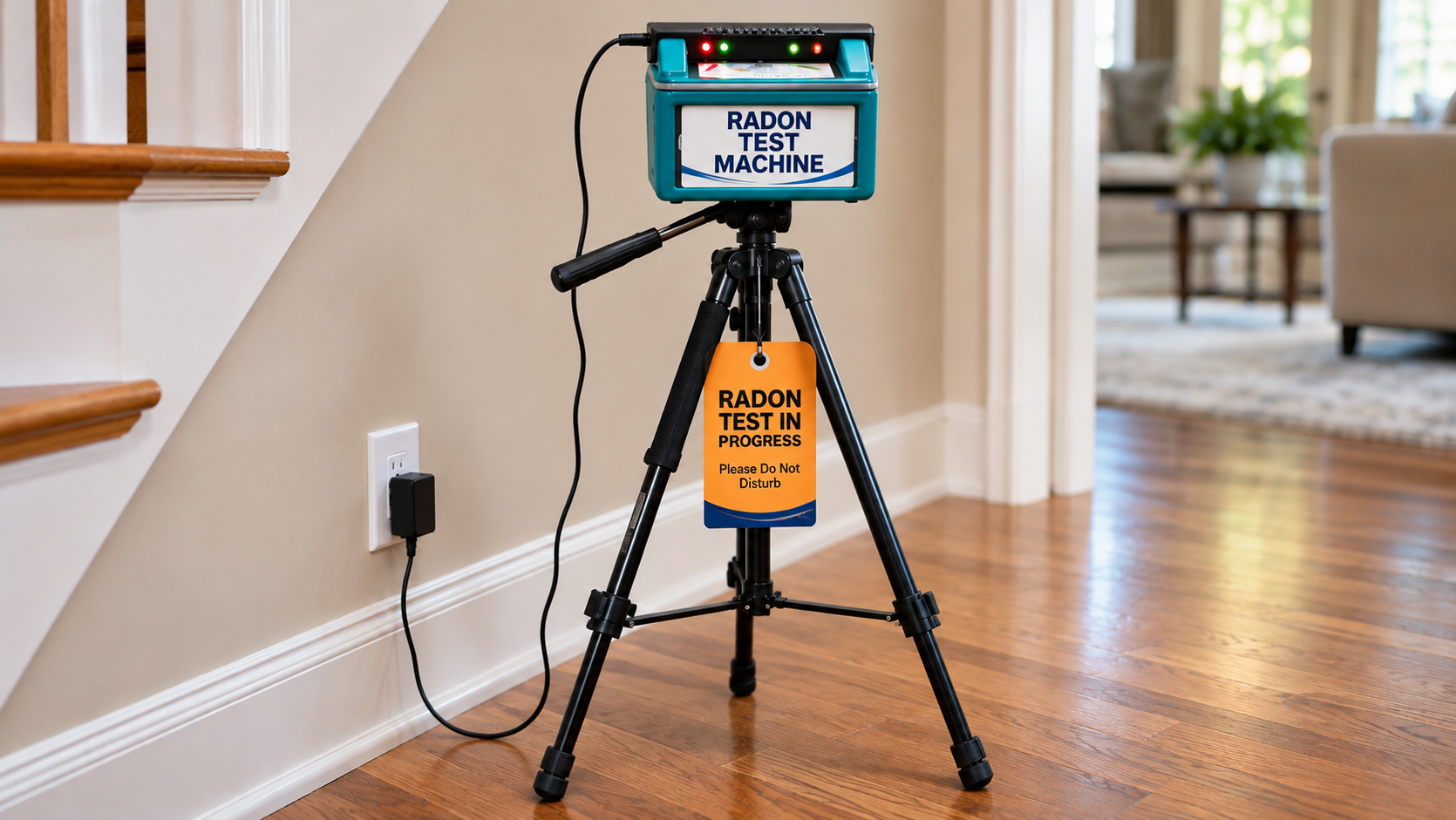
The test itself involves leaving a machine in the home (usually the first floor, or the basement if the home has one) for 48 to 72 hours, which takes hourly readings throughout the testing period. At the end, the results are averaged out. Professionals typically request the home owner leave windows and doors shut and ceiling fans off throughout the testing period. The inspector can pull the data for you from the testing device after the testing period pretty quickly.
What Elevated Radon Levels Mean for Your Purchase
If results come back at or above the EPA’s 4 pCi/L action level, you have options. Elevated radon is not a deal-breaker. It is a negotiation point.
Sub-slab depressurization (most common in the Triangle). A certified mitigation contractor installs a PVC pipe through the foundation slab and a fan that draws radon from beneath the slab and vents it outside before it enters the home. This method is effective for the vast majority of NC homes. Cost in the Raleigh market: usually $1,200 to $3,000, with most jobs landing around $1,800 to $2,200. The square footage of the home is the primary factor in the pricing.
Sealing. Contractors seal cracks and openings in the foundation to reduce entry points. This is often done in combination with depressurization for maximum effectiveness.
Post-mitigation testing. After any mitigation work, a follow-up short-term test confirms the system is performing as expected. This is standard practice and should be included in any mitigation quote.
Your negotiation strategy: When results come back elevated, you have four paths. You can ask the seller to install a mitigation system before closing. You can negotiate a credit to cover mitigation costs. You can purchase the home as-is and arrange mitigation yourself after closing. Or you can walk away during the due diligence period with your due diligence fee at risk but your earnest money protected.
For guidance on how to approach negotiation after inspection findings, including elevated radon, see how to negotiate after a home inspection as a buyer in Raleigh NC.
What a Mitigation System Looks Like
Many buyers who encounter a home with an existing radon mitigation system are not sure whether that is a red flag or a green light. The answer is: a properly installed, functioning mitigation system is a green light.
A mitigation system typically consists of a small fan unit (often in the garage, crawl space, or exterior wall) attached to a PVC pipe that runs under the foundation. It operates continuously and quietly. A manometer gauge on the pipe indicates the system is creating negative pressure. Most systems use very little electricity, roughly equivalent to a small light bulb running 24 hours a day.
If a home you are considering already has a mitigation system, ask for documentation that it was professionally installed and when it was last inspected. A post-installation test showing levels below 4 pCi/L is a good sign. An older system without recent testing is worth retesting during due diligence to confirm it is still performing.
Other Radon Testing Facts Triangle Buyers Ask About
Radon levels can vary significantly between neighboring homes on the same street. The geology under the specific property, the foundation type, and the home’s construction details all affect accumulation. A result from a neighbor’s home tells you nothing useful about yours.
Newer homes are not necessarily lower-risk. New construction homes are sometimes tested during building permit processes, but that is not universal in NC. Ask the builder or seller whether a radon test was conducted and request the results.
Homes with crawl spaces may have different radon dynamics than slab-on-grade or basement homes. A certified inspector knows how to place the test canister appropriately for the foundation type.
If you want to understand how the radon test fits into your broader due diligence rights as a buyer, my article on home inspections and the due diligence period gives you the full picture of what the due diligence period covers and what protections you have.
In my personal experience working with hundreds of clients at this point, condos in downtown Raleigh (around Fayetteville Street and adjacent blocks), and homes in Durham and Wake Forest have had more higher levels of radon than the rest of the Triangle. Again, I always have and always will encourage every buyer client of mine to test for radon regardless of location, price point or structure type.
Also worth reading: WRAL’s reporting on radon risk in the Triangle covers local testing results and context specific to the Raleigh market.
Frequently Asked Questions
Is radon testing required when buying a home in North Carolina?
Radon testing is not legally required in North Carolina residential real estate transactions, but it is strongly recommended. NC falls within EPA Radon Zone 2, meaning moderate radon potential exists across much of the Triangle area. Buyers who skip radon testing are making a decision without information that costs $125 to $200 to obtain. Most Triangle real estate agents advise clients to include radon testing as a standard part of the due diligence inspection process.
What radon level is dangerous in a Raleigh home?
The EPA recommends action when radon levels reach or exceed 4 picocuries per liter (pCi/L). Levels below 2 pCi/L are considered low risk. Levels between 2 and 4 pCi/L are moderate and warrant monitoring. At or above 4 pCi/L, mitigation is recommended. In the Raleigh market, sub-slab depressurization systems typically reduce levels to below 2 pCi/L and cost $1,200 to $2,00. The NC DHHS Radon Program is the authoritative source for NC-specific guidance on action levels and mitigation standards.
Can I negotiate radon mitigation with the seller in NC?
Yes. Elevated radon results discovered during due diligence are a negotiating point in North Carolina real estate transactions. Buyers can request that the seller install a mitigation system before closing, negotiate a repair credit to cover the cost, or purchase the home as-is and arrange mitigation themselves. Since mitigation costs are well-defined ($1,200 to $2,000 for most Triangle homes), this is a straightforward negotiation compared to open-ended repair requests. Your agent should help you frame the request based on the current state of negotiation and the seller’s situation.
How long does a radon test take during the home inspection?
A short-term radon test requires 48 to 72 hours of continuous exposure. Depending on the testing device used, results are usually available quickly. Coordinate timing with your inspector when scheduling your home inspection.
What if the home already has a radon mitigation system installed?
An existing mitigation system is not a red flag. A professionally installed, functioning mitigation system means a prior owner identified elevated radon and addressed it properly. Ask for the original installation documentation and any post-mitigation test results. If the system has not been tested in more than two years, request a short-term retest during due diligence to confirm it is still performing effectively. A functioning system with a current clean test result is a positive for the home.
Radon testing adds a small cost and a few extra days to your due diligence process. It gives you information that can protect your family’s health and give you a negotiation point if levels are elevated. For a $125 to $200 test on what is likely the largest purchase of your life, it is one of the easiest decisions in a home purchase.
If you have questions about the inspection process, what to test for, or how to handle findings before closing, I am happy to walk through it with you. Email brandon@theoceanairerealty.com or call or text 910-228-6481.
About Brandon Yopp
Brandon Yopp is a top-producing REALTOR® with The Oceanaire Realty, serving sellers and buyers across Raleigh, Durham, Chapel Hill, Cary, Apex, and the surrounding Triangle communities in North Carolina. A Triangle resident for more than 20 years, Brandon is known for deep local market knowledge, strategic pricing, expert negotiation, and a marketing approach built to give sellers maximum exposure across the platforms today’s buyers actually use. He’s a multi-year Triangle Real Producers Top 500 honoree and a Certified Luxury Home Marketing Specialist™, guiding first-time buyers, upsizers, downsizers, relocating clients, and investors through the Triangle market with confidence. Over 90% of his business comes from repeat clients and referrals.