
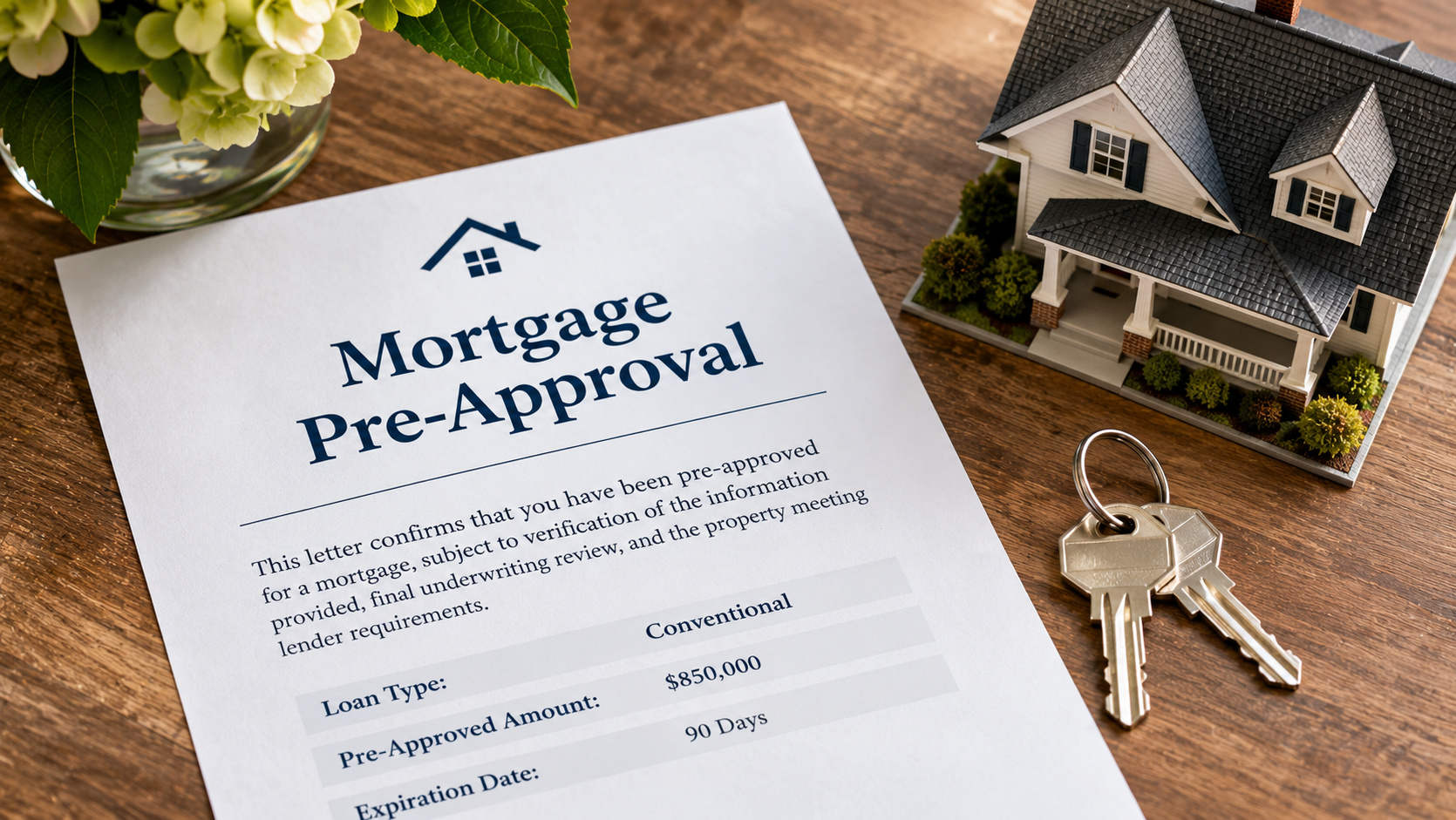
Mortgage Pre-Approval vs. Pre-Qualification in Raleigh, NC: What’s the Difference and Why It Matters
One of the most common questions I hear from buyers getting started in the Triangle market is whether a pre-qualification letter is enough to start making offers. The short answer is no — not in North Carolina, and especially not in Raleigh. Here is why the distinction matters, and what you should do before you write your first offer.
What Pre-Qualification Actually Means
Pre-qualification is an informal process. You tell a lender your income, your debts, your assets, and your credit score (often just an estimate). The lender runs those numbers through their calculator and tells you what you might be able to borrow. No credit pull. No documentation review. No underwriting.
The result is a letter that says something like: “Based on the information provided, this borrower may qualify for a loan up to $X.” That phrase — “based on the information provided” — is doing a lot of work. The lender has not verified anything. They have no idea if your W-2 matches what you told them, whether your bank statements show the savings you described, or whether your credit report reveals a collection account you forgot about.
A pre-qualification letter is useful for one thing: getting a rough sense of what price range to shop in before you are ready to commit to a full application. It is not a financing commitment, and it is not a signal of offer strength.
What Pre-Approval Actually Means
Pre-approval is a different animal. To get a true pre-approval, you submit a formal loan application and provide documentation:
- W-2s or tax returns for the past two years
- Recent pay stubs (typically the last 30 days)
- Bank statements for the past 60 to 90 days
- Documentation of other assets (retirement accounts, investment accounts)
- Authorization for a hard credit pull
The lender reviews all of this, often running it through an automated underwriting system. At the end, you receive a pre-approval letter that specifies the loan program, the maximum purchase price, the loan amount, and sometimes the rate range. This letter says: “We have reviewed this borrower’s financial picture and they qualify for this loan.”
A pre-approval letter is typically valid for 90 days. It can be updated if your financial situation changes materially. For most lenders, the full pre-approval process takes one to three business days once you submit your documentation.
The Consumer Financial Protection Bureau’s mortgage process resources explain the federal standards around what documentation lenders should review during the pre-approval process.
Why This Distinction Is Especially Important in NC
Here is where North Carolina adds layers that most buyer guides skip over.
The due diligence fee is non-refundable. In NC, the standard purchase contract (NC Form 2-T) requires buyers to pay a due diligence fee directly to the seller at the time the contract is executed. This fee is non-refundable unless the seller is in default. You can terminate the contract during the due diligence period for any reason and get your earnest money back — but the due diligence fee stays with the seller.
What does that have to do with pre-approval? Everything. If your financing falls apart after you go under contract — say, your lender pulls the pre-approval because an underwriter finds an issue with your documentation — you still lose the due diligence fee. Coming in with a true pre-approval, where your financial picture has already been reviewed by an underwriter, dramatically reduces the risk that your financing collapses mid-contract. For more on how the NC due diligence structure works, our guide to the NC due diligence fee covers the mechanics in full detail.
NC Form 2-T has no financing contingency. In many states, buyers can include a financing contingency in their offer — if their loan does not come through, they can walk away and recover all their deposits. North Carolina’s standard contract does not work that way. There is no built-in financing contingency. If your financing falls through after the due diligence period ends, you face the potential loss of your earnest money as well. A solid pre-approval before you write offers is your primary financial protection in a NC transaction.
Sellers evaluate financing letters. In Raleigh’s current market — where buyers have more choices and sellers are more selective about which offers they accept — sellers and their agents read financing letters carefully. A pre-qualification letter from an online lender signals “this buyer has not been vetted.” A pre-approval letter from a reputable local lender signals “this buyer’s finances have been reviewed and confirmed.” When a seller is weighing two otherwise similar offers, the quality and type of financing letter matters.
For a full picture of how offers are structured and evaluated in Raleigh, our guide to writing a strong offer covers the DD fee, escalation clauses, and what makes an offer stand out.
How to Get Pre-Approved the Right Way
Choose your lender first. The lender you choose affects more than just your rate. Local lenders and credit unions with Triangle experience know NC’s attorney-closing timeline, understand the due diligence process, and can close in 30 to 45 days without surprises. National online lenders may offer competitive rates but sometimes struggle with NC-specific contract mechanics. Our guide to choosing a lender walks through what to compare.
Shop multiple lenders without hurting your credit. The credit bureaus treat mortgage inquiries from multiple lenders within a 14 to 45-day window as a single inquiry for scoring purposes. You can get pre-approved by two or three lenders, compare terms, and choose without material damage to your credit score.
Know the difference between pre-approval and final loan approval. A pre-approval is not a final loan commitment. The lender still needs to approve the specific property (through appraisal and title review), verify that your financial picture has not changed between pre-approval and closing, and complete underwriting. Major changes between pre-approval and closing — a new car loan, a job change, large unexplained deposits — can jeopardize your final approval. For how the rate lock fits into this process, our mortgage rate lock guide explains when to lock and what to expect.
Ask about a fully underwritten credit approval. Some lenders now offer a fully underwritten credit approval, sometimes called a TBD approval, credit commitment, or “verified” pre-approval. This goes one step further than a standard pre-approval — an actual underwriter reviews your file before you even find a property. This is the strongest possible financing signal you can present to a seller. If your situation is at all complicated (self-employed income, recent job change, multiple income streams), this is worth pursuing.
Redfin’s explanation of pre-approval vs. pre-qualification provides a useful national-level comparison. The NC-specific dynamics described here — the due diligence fee and no financing contingency — make the stakes higher in this market than in most.
Frequently Asked Questions
How long does mortgage pre-approval take in Raleigh NC?
For most buyers with straightforward finances — W-2 income, standard documentation — a true pre-approval takes one to three business days once you submit your documents. If your situation is more complex (self-employment, recent job change, previous credit issues), plan for three to five days. Many local lenders in the Triangle can turn around same-day or next-day pre-approvals for straightforward files. Pre-qualification is usually instant — but as explained above, it carries much less weight in the NC market.
Can I make an offer on a Raleigh home with just a pre-qualification letter?
You can make an offer with any type of financing letter. But sellers are under no obligation to give a pre-qualification letter equal weight to a pre-approval. In a competitive situation, a pre-qualification signals unverified financing and reduces your offer’s perceived strength. With NC’s non-refundable due diligence fee at stake, it also means you are taking on more personal financial risk if your financing falls through.
Does getting pre-approved hurt my credit score?
A single hard credit inquiry from a mortgage pre-approval lowers most people’s scores by fewer than five points and typically recovers within a few months. If you apply with multiple lenders within a 14 to 45-day window, the credit bureaus count all mortgage inquiries as one — so shopping around does not compound the impact. The temporary small dip is a reasonable cost of knowing your real buying power before you sign a contract with a non-refundable deposit attached.
What is the difference between earnest money and the due diligence fee in NC?
These are two separate deposits in NC. The due diligence fee is paid directly to the seller at contract execution and is never refundable (unless the seller is in default). It compensates the seller for taking the home off the market during the buyer’s due diligence period. Earnest money is held in escrow and is refundable if you terminate during the due diligence period — but is at risk if you terminate after the DD deadline without the seller’s consent. For a full breakdown, our guide on earnest money vs. the due diligence fee covers both in detail.
How long is a mortgage pre-approval valid?
Most pre-approval letters are valid for 90 days from the date of issue. After 90 days, the lender will typically ask you to update your documentation — pay stubs, bank statements, and sometimes a new credit pull — before reissuing the letter. If interest rates or your financial picture have changed materially, your pre-approved amount may also change.
The best thing you can do before you start touring homes in Raleigh is get a true pre-approval — not just a pre-qualification — from a lender who understands NC’s purchase process. It protects your due diligence fee, strengthens your offers, and means you know your real numbers before you fall in love with a house.
If you are getting ready to buy in the Raleigh area and want to talk through the process — including how financing fits into NC’s due diligence structure — let’s get on a call. The best next step is a quick conversation. I offer confidential consultations to walk through your situation, the buying process, and any questions you have. Email brandon@theoceanairerealty.com or call or text 910-228-6481.
About Brandon Yopp
Brandon Yopp is a top-producing REALTOR® with The Oceanaire Realty, serving sellers and buyers across Raleigh, Durham, Chapel Hill, Cary, Apex, and the surrounding Triangle communities in North Carolina. A Triangle resident for more than 20 years, Brandon is known for deep local market knowledge, strategic pricing, expert negotiation, and a marketing approach built to give sellers maximum exposure across the platforms today’s buyers actually use. He’s a multi-year Triangle Real Producers Top 500 honoree and a Certified Luxury Home Marketing Specialist™, guiding first-time buyers, upsizers, downsizers, relocating clients, and investors through the Triangle market with confidence. Over 90% of his business comes from repeat clients and referrals.