
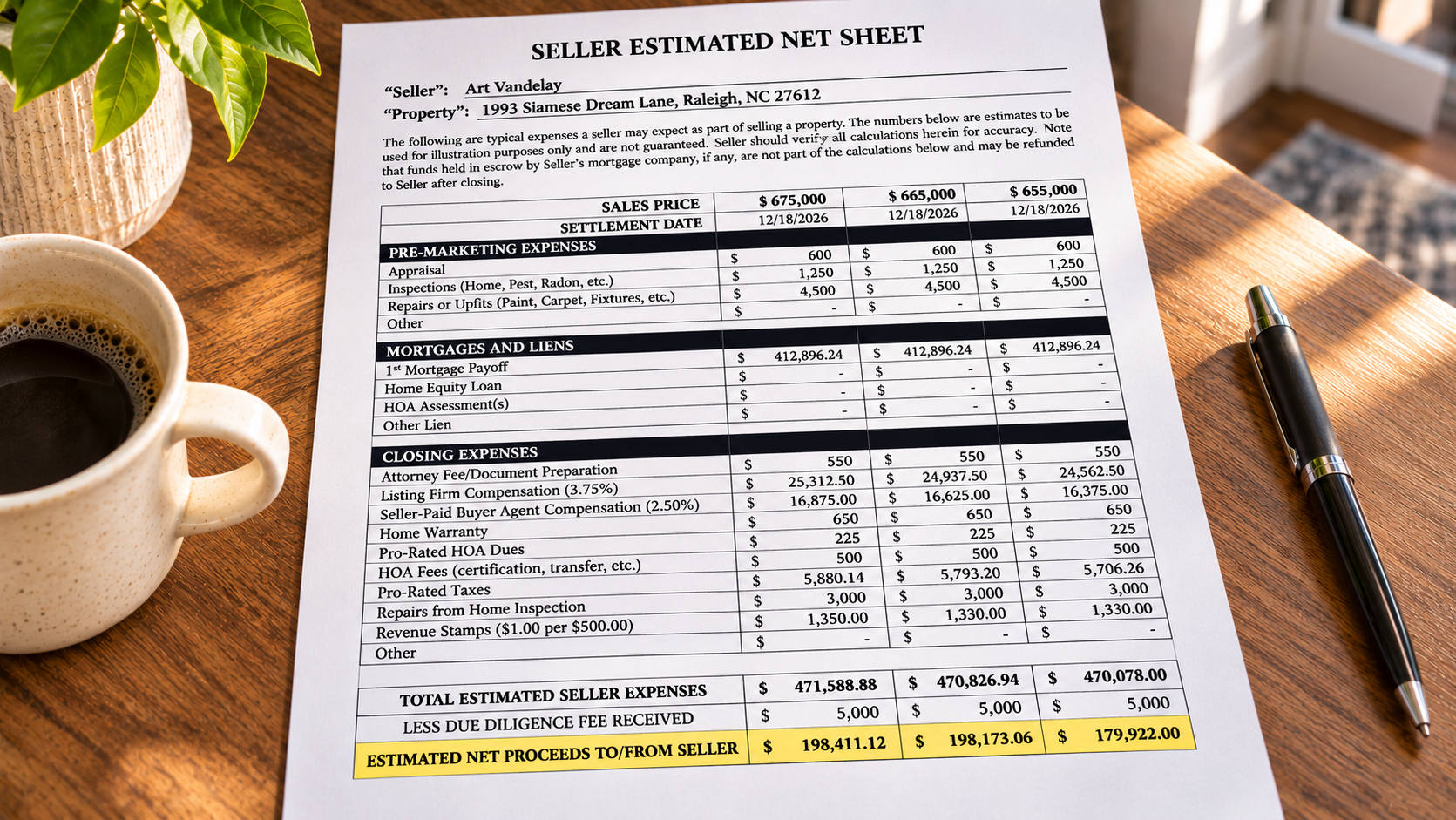
What Is a Seller’s Net Sheet in Raleigh, NC? How to Read It and Use It When Evaluating Offers
The number at the top of the offer isn’t your money. The number at the bottom of the net sheet is.
A lot of sellers focus on the sale price and that’s understandable. It’s the headline figure. But what you actually walk away with depends on a chain of deductions that most sellers haven’t thought through until they’re staring at the closing disclosure two days before closing.
The seller’s net sheet is the tool that closes that gap. It’s a working estimate your agent produces at any point in the transaction — before you list, when you price, or the moment you receive an offer. And when you receive multiple offers, running the net sheet on each one is the only way to know which one actually puts more money in your pocket.
Here’s how it works, what every line means, and how to use it.
What a Seller’s Net Sheet Actually Is
A net sheet is a non-binding estimate, not a guarantee, and not the same as the closing disclosure you’ll sign at the attorney’s office. It’s a projection built from known and estimated costs, designed to show you a realistic range for your proceeds.
The NC Association of REALTORS® has a standard Seller Estimated Net Sheet form that most agents in the Triangle use as their baseline. Some agents use their own version. The format varies, but the contents should cover the same categories.
Your agent should run this for you:
- Before you price — to understand what a likely sale price will actually net you
- When you receive any offer — to translate offer price into take-home dollars
- When comparing multiple offers — because the highest offer isn’t always the one that nets the most
This last point is the one that surprises sellers most. An offer of $625,000 with $12,000 in seller-paid closing cost concessions can net you less than a $618,000 offer with no concessions, once you run the actual numbers.
The Line Items You’ll See — and What Each Means
Here’s what a typical Raleigh net sheet includes:
Sale Price
Your starting point. Everything below is a deduction from this number.
Agent Commission
Still the largest single deduction for most sellers. Post-NAR settlement, commissions are negotiable. There’s no such thing as a “standard” rate, and the buyer’s agent compensation is now separately negotiated. Your listing agent should be clear with you about what’s being offered to the buyer’s agent and what your total commission cost is. For planning purposes, many Raleigh sellers budget 5–6% of the sale price, though this varies widely depending on the transaction.
NC Excise Tax (Revenue Stamps)
North Carolina charges $1 per $500 of sale price, paid by the seller. On a $600,000 home, that’s $1,200. On a $750,000 home, it’s $1,500. This is a fixed, predictable number — there’s no negotiating it. It goes to the Wake County Register of Deeds at closing. You can read the full statute at NC General Statutes Chapter 105.
Closing Attorney Fees
North Carolina is an attorney-closing statehe closing must be conducted by a licensed NC attorney. The attorney title search, title examination, deed preparation, and closing supervision typically cost $800–$1,200 for the seller’s portion. This is separate from title insurance (which the buyer typically purchases) and from lender fees. The attorney also handles wire transfers and deed recording.. T
Deed Preparation and Recording Fees
The attorney prepares the new deed and records it with the county. Deed prep typically runs $150–$250. Recording fees vary by county but are usually under $100.
Mortgage Payoff
If you have an existing mortgage, the net sheet should include your estimated payoff, which is the remaining principal balance plus any interest accrued through the closing date, plus any prepayment penalty if applicable. This is the number that matters most if you’re close to breaking even. Your lender can give you a payoff quote that’s accurate to within a week.
Property Tax Proration
North Carolina prorates property taxes on a calendar-year basis. If you close in November, you’ve lived in the home for about 10.5 months of the tax year, so you owe the buyer credit for approximately 10.5 months of that year’s taxes. Wake County issues property tax bills in September, due January 5. If the closing happens before you’ve paid the year’s tax bill, the buyer receives a credit at closing, which shows as a deduction on your net sheet.
Seller Concessions
If you’ve agreed to pay the buyer’s closing costs, offer a repair credit, or buy down the buyer’s rate, those amounts appear here as deductions. This is where comparing offers gets nuanced — a full-price offer with $15,000 in concessions may net less than a slightly lower offer with none.
Pre-Listing Repairs and Carrying Costs
The net sheet your agent runs at the time of listing may include any agreed-upon pre-listing repairs or staging costs. These are real costs that reduce your actual net, even though they don’t appear on the closing statement.
Estimated Net Proceeds (Low / Base / High range)
A well-prepared net sheet will show a range — not a single number — because some line items (especially the mortgage payoff and property taxes) are estimated until closing. The range accounts for normal variation in final figures.
How to Use the Net Sheet When Comparing Offers
When multiple offers come in, run the net sheet on each one before you respond.
The variables that change between offers:
- Purchase price
- Due diligence fee (this is cash in hand the moment you go under contract — it doesn’t appear as a deduction)
- Requested concessions
- Closing timeline (affects property tax proration and carrying cost)
- Financing type (which may affect appraisal risk and closing timeline, factors your agent will weigh alongside net)
A buyer offering $615,000 with no concessions and a $5,000 due diligence fee will net you more than a buyer offering $620,000 with $12,000 in closing cost credits and a $1,000 due diligence fee, even though the sale price is higher. Running the numbers before you counter or accept is the only way to see that.
Your agent should also note which offers carry more risk of falling through, which matters when you’re weighing a slightly higher net against transaction certainty. That judgment call — price, net, risk, timeline — is exactly what a good listing agent is paid to help you make. For more on evaluating competing offers, see the Multiple Offers Seller Guide for Raleigh NC.
What the Net Sheet Doesn’t Include
A few things that affect your final take-home but typically don’t appear on the net sheet:
Capital gains tax. If you’ve owned the home for more than two years as a primary residence, the first $250,000 of gain ($500,000 for married filing jointly) is typically excluded under Section 121 of the federal tax code. But if your gain exceeds that threshold, or if the property was not your primary residence, federal and NC capital gains taxes apply. Brandon discussed this in detail in Capital Gains Tax on Selling Your Home in Raleigh NC.
Post-closing credits. If the buyer discovers defects after closing and pursues a claim, any settlement is not reflected in the original net sheet. This is one reason accurate disclosure up front matters so much.
Moving and transition costs. Not a closing-related item, but real money that affects your overall financial picture from the sale.
When to Ask for a Net Sheet
The right time to ask is before you need it.
If you’re thinking about listing, ask your agent to run a net sheet at two or three different sale prices — say, your target price, 3% lower, and 5% lower. That shows you the range of likely outcomes and helps you plan your next purchase around realistic numbers, not the best-case scenario. You can also start with a home valuation at Brandon’s free home valuation tool to get a ballpark before the full analysis.
When offers come in, don’t sign anything until you’ve seen the net sheet on each offer. A good listing agent will have this ready before you discuss whether to accept, counter, or reject. And if you’re newer to the selling process, the overview of what to expect at closing as a seller in Raleigh NC gives full context for how closing day fits into the full transaction.
In my personal business, I present a seller net sheet to prospective seller clients once we start discussing potential list prices before the listing agreement is signed, and then again once we begin negotiating offer terms.
Frequently Asked Questions
What is the difference between a seller’s net sheet and the closing disclosure?
A seller’s net sheet is a working estimate your agent prepares before closing, based on projected costs. The closing disclosure (CD) is the final, binding document prepared by the closing attorney that reflects the actual amounts due at settlement. The two should be close to each other, but the CD is the one you sign. If the final numbers differ significantly from the net sheet estimate, ask your agent to walk through the variance before you sign.
How much do Raleigh home sellers typically net after all costs?
Most Raleigh sellers net between 7% and 9% less than the sale price when you factor in agent commissions, NC excise tax, attorney closing costs, mortgage payoff, and any agreed-upon concessions. On a $600,000 sale, that means roughly $42,000 to $54,000 in total deductions before you receive your proceeds. Your exact net depends on your commission structure, mortgage balance, concessions offered, and the specific terms of your contract.
Does the NC excise tax apply to every home sale in Wake County?
Yes. The NC excise tax (also called revenue stamps) applies to all residential real estate sales in North Carolina, including Wake County, Durham County, and across the Triangle. It is calculated at $1 per $500 of the sale price and is almost always paid by the seller (with the exception of most new construction). On a $550,000 home, the excise tax is $1,100. There are no exemptions for primary residences, long-term ownership, or first-time sellers under NC General Statutes § 105-228.28 et seq.
How are property taxes handled on a seller’s net sheet in NC?
North Carolina prorates property taxes on a calendar-year basis as of the closing date. If you close mid-year, you owe a credit to the buyer for the portion of the year’s taxes covering January 1 through the day before closing. Wake County’s tax bills are issued in September and due January 5, so if you close before paying the year’s bill, the proration credit comes out of your proceeds at closing. The closing attorney calculates the exact amount based on the most recent tax bill or the prior year’s figures if the new bill isn’t yet available.
Can you get a seller’s net sheet before you list your home?
Yes, and you should. A pre-listing net sheet shows you what you’re likely to walk away with at several different price points, which helps you decide whether the timing makes financial sense, how to plan your next purchase, and whether it’s worth making pre-listing improvements that might affect your sale price. Any experienced Raleigh listing agent should be able to run this for you as part of a no-cost seller consultation.
The net sheet is one of the clearest windows into what selling your home actually means for your financial picture. If you have questions about your specific situation, or want to see the numbers before you decide whether to list, reach out anytime. Email brandon@theoceanairerealty.com or call or text 910-228-6481 for a confidential conversation with no pressure and no commitment.
About Brandon Yopp
Brandon Yopp is a top-producing REALTOR® with The Oceanaire Realty, serving sellers and buyers across Raleigh, Durham, Chapel Hill, Cary, Apex, and the surrounding Triangle communities in North Carolina. A Triangle resident for more than 20 years, Brandon is known for deep local market knowledge, strategic pricing, expert negotiation, and a marketing approach built to give sellers maximum exposure across the platforms today’s buyers actually use. He’s a multi-year Triangle Real Producers Top 500 honoree and a Certified Luxury Home Marketing Specialist™, guiding first-time buyers, upsizers, downsizers, relocating clients, and investors through the Triangle market with confidence. Over 90% of his business comes from repeat clients and referrals.