New Construction vs. Resale in Raleigh, NC: Which Is the Better Deal in 2026?
The Price Story Is More Complicated Than It Looks
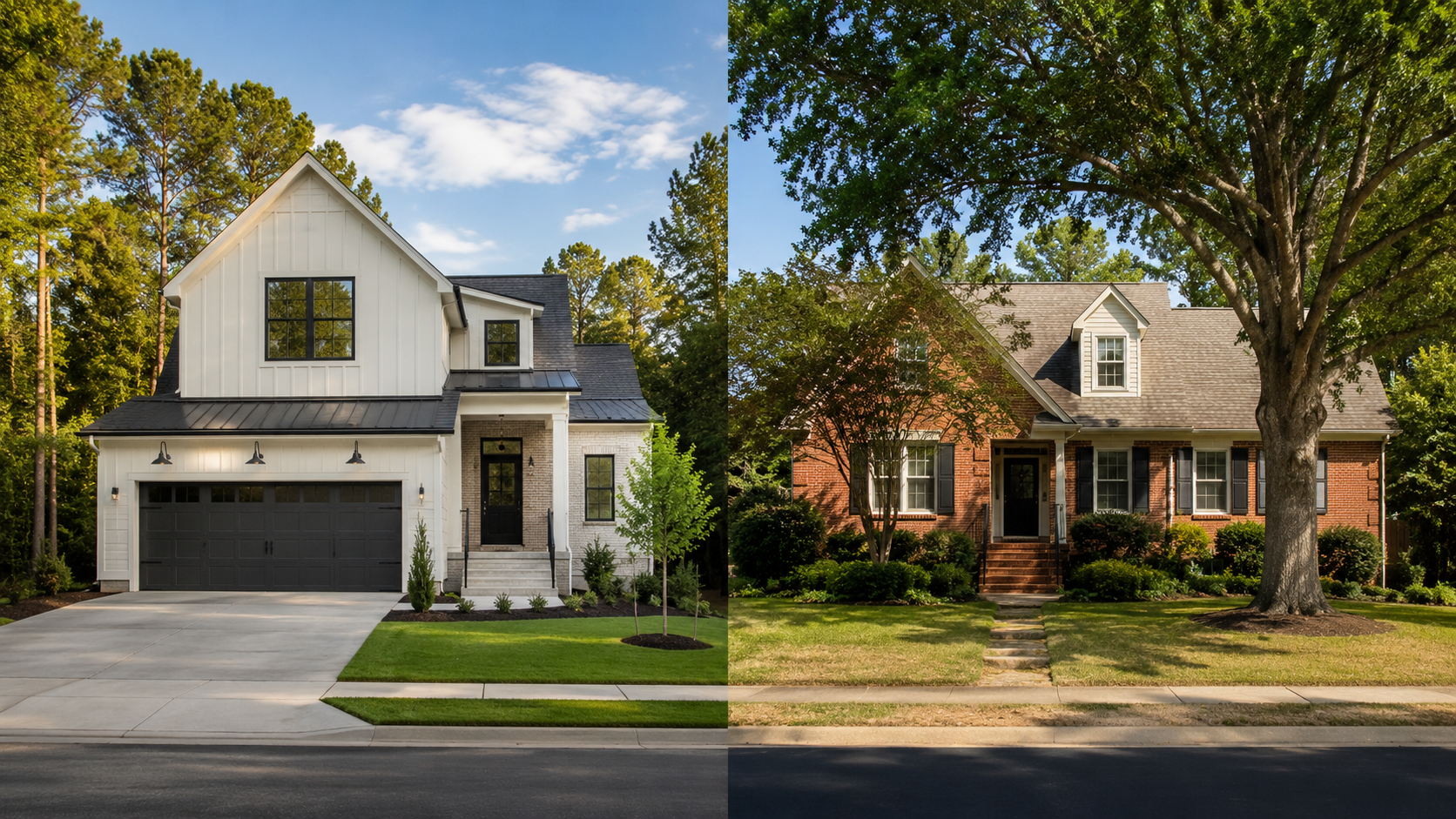
The near-identical median prices in Raleigh can give the impression that new construction and resale are trading at parity. They are not, at least not on a true apples-to-apples basis. On comparable square footage in comparable areas, new construction still carries a 10 to 20 percent premium over resale. What has changed is how aggressively builders are closing that gap.
According to national data tracked by the National Association of Home Builders, roughly 41 percent of homebuilders reduced prices in 2025 and into 2026, with average cuts around 6 percent. Many Triangle builders are layering incentives on top of those reductions: closing cost credits of $10,000 to $25,000, use-as-you-choose flex funds, and mortgage rate buydowns that can bring your effective rate meaningfully below market. Builders at Wendell Falls offered $25,000 in option credits on select homes, and several Triangle-area builders advertised $20,000 to $30,000 incentive packages for buyers who use their preferred lender.
Those preferred-lender incentives come with an important data point. In Q3 2025, new-construction buyers who used builder financing saw average 30-year mortgage rates of 5.27 percent versus 6.26 percent for existing-home buyers. Over a 30-year loan at today’s prices, that rate gap represents tens of thousands of dollars in interest savings — a real consideration alongside any sticker-price comparison.
On the resale side, sellers in Wake County offered concessions on about 47 percent of transactions in 2026, and homes are selling at roughly 98 to 99 percent of asking price on average. That means room to negotiate on price, credits, and closing cost assistance — particularly in buyer-favorable submarkets like Wake Forest, Knightdale, and Wendell, where new construction inventory has put downward pressure on resale pricing.
For a deeper look at how to use those concession rates in a resale negotiation, see our guide to negotiating a home purchase in Raleigh NC.
What New Construction Actually Gives You (And What It Doesn’t)
The clearest advantages of new construction are not in the price. They are in what comes with the home.
Warranty coverage. In North Carolina, builders of new homes carry both a written warranty and an implied legal warranty that the home will be habitable and constructed in a workmanlike manner. Most builders provide a one-year warranty on all components, a two-year warranty on mechanical systems, and a ten-year structural warranty. The NC Department of Justice consumer guidance on home warranties outlines what these warranties typically cover and what to watch for in the fine print — particularly arbitration clauses and restrictions on which contractors can perform warranty repairs.
Modern systems and energy efficiency. New construction homes in the Triangle use current insulation standards, HVAC equipment, windows, and roofing — all with long remaining useful lives. A resale home may have a 12-year-old roof and an 18-year-old HVAC system that will need replacement soon. Those costs are real and need to factor into any price comparison.
A different contract. New construction in NC uses NC REALTORS® Form 800-T rather than the standard resale Form 2-T. The 800-T includes a construction completion period instead of the typical due diligence period, along with specific provisions for construction plans, specifications, completion timelines, and inspection rights. Buyers coming from resale transactions should read this contract carefully — it is not the same document, and the protections work differently. Many builders, especially national and regional builders, actually use their own attorney drafted contract form as standard rather than the Form 800-T. Those contracts typically heavily favor the builder and should be carefully reviewed with your agent. For a detailed walkthrough of the process, see our step-by-step guide to buying new construction in the Triangle.
Your buyer agent must be registered before or on the first model home visit. Builder sales representatives work for the builder. Bringing your own buyer agent ensures you have representation advocating for your interests rather than the builder’s. In most Triangle new construction transactions, the builder pays the buyer agent’s commission, so there is no cost to you for having your own representation. The new construction buyer resources on this site cover what to look for when evaluating builder communities across the Triangle. For a complete picture of how buyer agent compensation works in NC today, see our guide to who pays the buyer’s agent in Raleigh NC.
The risks buyers underestimate. Buying in an early development phase can be problematic if you plan to sell in three to five years. When comparable sales in your community are still builder new-construction sales at builder pricing with incentives, those comps can cap your resale value at a moment when the neighborhood is not yet fully established. HOAs in new construction communities often start with developer control and transition to resident control as the development fills — and the NC Department of Justice’s HOA guidance notes that no state or federal agency oversees HOA governance. Understand the projected fees, special assessments, and timeline to full community development before you commit.
What Resale Actually Gives You (And What It Doesn’t)
Resale homes offer something new construction fundamentally cannot: an established place in an established neighborhood.
Location. The most desirable Raleigh neighborhoods — Inside the Beltline, North Hills, Cary’s established communities, Apex’s walkable downtown area — are mostly built out. There are fewer opportunities for construction there, and what little opportunities exist are usually well above and beyond the average price point and typically closer to the luxury range. If location is your top priority, resale is your only path into those submarkets. The resale homes buyer page covers what to look for in the resale process across these established Triangle communities.
What you see is what you get. Mature trees, established landscaping, finished streets, nearby amenities, school patterns already in place, and neighbors who have been there long enough to tell you what the area is really like. These things take years to develop in a new community and cannot be replicated at any price.
A known contract. The standard NC Offer to Purchase and Contract (Form 2-T) governs resale transactions. It is a familiar document with well-established protections, a clear due diligence period structure, and a process that buyers and agents in the Triangle know well. There are no construction completion timelines, no builder-specific addenda, and no uncertainty about what gets built and when.
Negotiation room in today’s market. In the outer Wake County submarkets — Wake Forest, Knightdale, Wendell, Fuquay-Varina — resale sellers are competing directly with builder inventory and are often willing to negotiate more aggressively than they were two or three years ago. Buyers have leverage in these markets that did not exist in 2021 or 2022.
The honest trade-off. Resale homes come with history. That history includes potentially deferred maintenance, aging systems, unknown repairs by previous owners, and the as-is standard under NC law. A thorough inspection during the due diligence period is your protection — and getting the inspection right matters more on a resale home than it does on new construction. The sellers are not required to fix anything, but they are required to disclose known material defects on the RPOADS.
Frequently Asked Questions
Is new construction more expensive than resale in Raleigh NC?
At the median level in 2026, new construction and resale prices are nearly identical in the Raleigh-Cary area — approximately $450,767 versus $451,367. On a true square-footage-adjusted comparison, new construction still carries a 10 to 20 percent premium, but builder incentives of $10,000 to $30,000 and below-market mortgage rates through builder lenders can close much of that gap. In Wake County’s outer submarkets — Wake Forest, Knightdale, and Wendell — the competitive pressure of new inventory has brought both new construction and resale prices to levels buyers have not seen since 2020.
Do builders pay buyer agent commission in NC?
Yes, in most Triangle new construction transactions the builder pays the buyer agent’s commission. This is an important reason to bring your own representation: it costs you nothing and gives you an advocate whose interests align with yours rather than the builder’s. Register your agent before your first model home visit — once you tour a community without an agent registered, some builders will not allow you to add one later. In Wake County and across the Triangle, this practice is standard across both national and local builders.
What is the warranty on a new construction home in NC?
Most Triangle builders provide a one-year warranty on all workmanship and materials, a two-year warranty on mechanical systems (HVAC, electrical, plumbing), and a ten-year structural warranty covering major defects in load-bearing elements. North Carolina courts have also recognized an implied warranty that new homes are habitable and built in a workmanlike manner. Read the written warranty carefully before closing — some builder contracts limit your remedies to private arbitration and restrict which contractors can perform warranty repairs, which the NC Department of Justice flags as a common point of consumer concern.
Can I negotiate with a builder in Raleigh NC?
Yes, particularly in today’s market. Builders rarely reduce the base list price significantly because they need to protect comparable sales for future phases, but they have significant flexibility on incentives: closing cost credits, rate buydowns, option upgrades, lot premiums, and flex funds may all be negotiable. Your buyer agent, who works with builders regularly, will know which communities have the most room and which incentives are genuinely valuable versus promotional. In Wake County and the surrounding Triangle, buyers have more leverage with builders right now than at any point since 2020.
Should I buy new construction or resale if I plan to sell in 5 years?
Resale homes in established Raleigh-area neighborhoods tend to hold and grow value more predictably because their comparable sales are not subject to builder-pricing dynamics. New construction in an early development phase carries resale risk if the community is not complete when you sell — your buyers will compare your home against the builder’s new inventory, which may still be priced with incentives. If your five-year plan is firm, ask your agent to assess the development timeline of the specific community and project how many phases will be complete by the time you intend to sell — that analysis makes the decision much clearer.
There is no universal answer to which is the better deal — and anyone who tells you otherwise is not accounting for enough variables. The right choice depends on your timeline, the specific submarket, what the builder is offering this month, and what trade-offs you are genuinely comfortable making.
If you are weighing both options in the Triangle and want a realistic read on what each side actually costs and delivers in your specific price range, reach out. That is exactly the kind of conversation worth having before you step into a model home or write your first offer.
Brandon Yopp, REALTOR®
brandon@theoceanairerealty.com | 910-228-6481 (call or text)
About Brandon Yopp
Brandon Yopp is a top-producing REALTOR® with The Oceanaire Realty, serving sellers and buyers across Raleigh, Durham, Chapel Hill, Cary, Apex, and the surrounding Triangle communities in North Carolina. A Triangle resident for more than 20 years, Brandon is known for deep local market knowledge, strategic pricing, expert negotiation, and a marketing approach built to give sellers maximum exposure across the platforms today’s buyers actually use. He’s a multi-year Triangle Real Producers Top 500 honoree and a Certified Luxury Home Marketing Specialist™, guiding first-time buyers, upsizers, downsizers, relocating clients, and investors through the Triangle market with confidence. Over 90% of his business comes from repeat clients and referrals.