Common Home Inspection Findings in Raleigh, NC: What Triangle Buyers Should Expect in 2026
Every home in the Triangle has something an inspector will flag. That is not a problem — it is normal. Even a well-maintained, recently renovated home typically produces an inspection report with several items worth noting. What matters is understanding which findings are routine maintenance items, which are significant enough to affect the transaction, and which are specific to homes in the Raleigh market and the NC climate.
The buyers who navigate inspection findings most effectively are the ones who knew what to expect going in. This guide covers the most common findings in Triangle homes, what they typically mean, and how they fit into the NC due diligence process.
The NC Due Diligence Framework and Inspection Timing
Before getting into what inspectors typically find, it is worth understanding how inspections fit into the NC contract structure. North Carolina’s standard purchase contract does not include a traditional home inspection contingency. Instead, buyers have a negotiated due diligence period — typically 15 to 21 days in the current Triangle market — during which they can order any inspections they choose, evaluate findings, and terminate the contract for any reason to receive their earnest money back.
The practical implication: move quickly on inspections. Book your general home inspector, your pest inspector, and any specialists you need in the first week of due diligence. That leaves time to receive reports, evaluate findings, get repair estimates if needed, and decide whether to negotiate, terminate, or proceed — all before the due diligence deadline. For the full breakdown of how the NC due diligence structure works, the NC due diligence fee guide covers the mechanics. I aim to have all inspections completed for my buyer clients within 10 business days of going under contract. That allows us to have plenty of time to get quotes for repairs if needed, or a second opinion.
Crawl Space Issues: The Triangle’s Most Common Concern
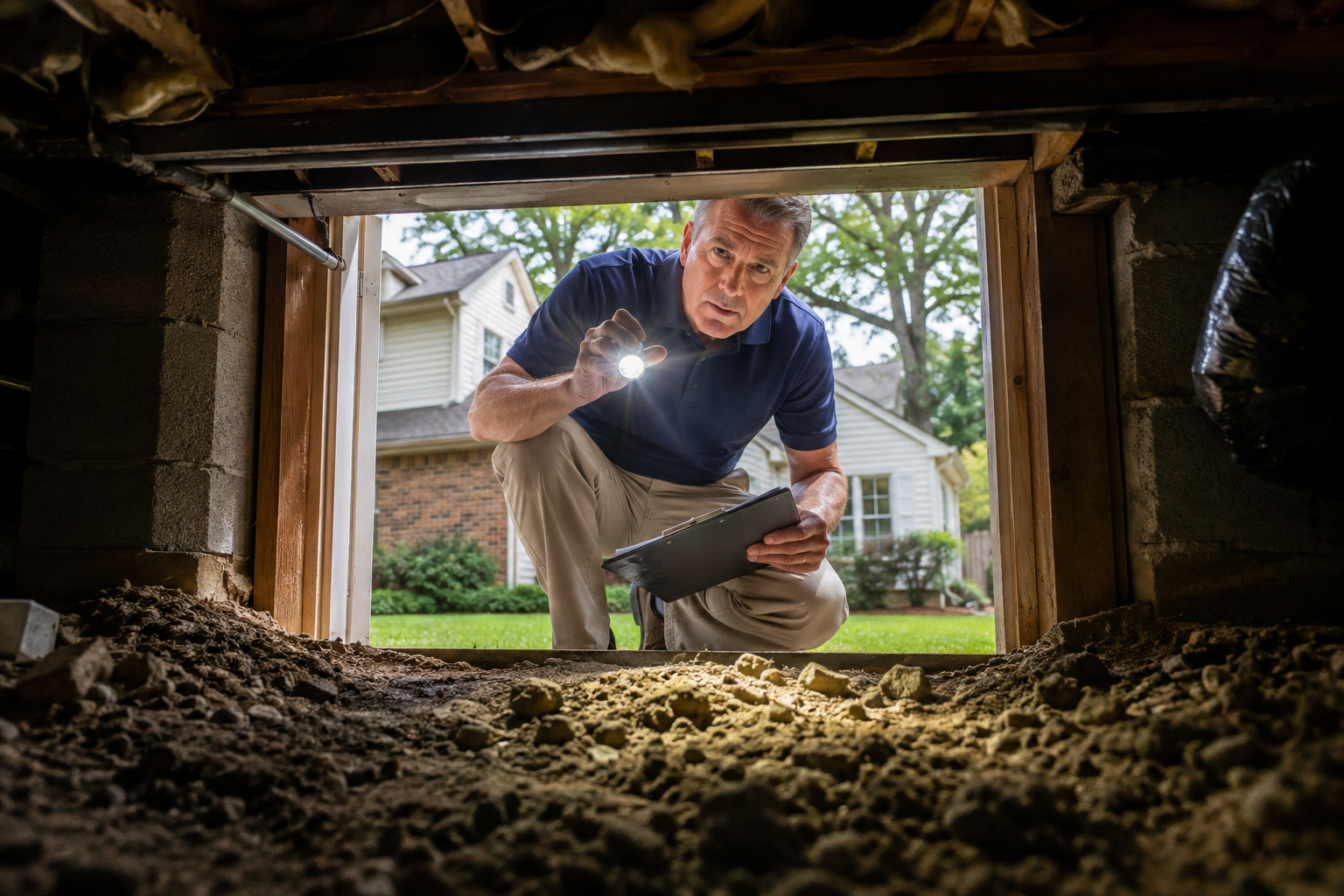
If there is one single inspection finding that appears in more Triangle home reports than any other, it is crawl space moisture. The Raleigh area’s combination of clay soil, high humidity, warm summers, and seasonal temperature swings creates conditions that stress crawl spaces in ways that buyers from drier climates do not immediately anticipate.
What inspectors find: Standing water or saturated soil after rain events, improper or missing vapor barrier coverage, inadequate or blocked crawl space ventilation, wood structural members showing elevated moisture readings above 19% (the threshold at which fungal growth becomes a risk), existing fungal growth or mold on joists and subfloor framing, and improper grading around the foundation perimeter that directs water toward rather than away from the home.
What it means: Minor vapor barrier repairs and improved grading are common maintenance items and relatively inexpensive to address. Significant fungal growth, elevated moisture throughout the crawl space, or standing water that recurs across seasons represents a more meaningful concern — remediation can range from a few thousand dollars for localized treatment to $15,000 or more for full encapsulation systems with drainage and dehumidification.
Practical guidance: Ask for a pest inspection that specifically includes wood-destroying organism (WDO) documentation, as crawl space moisture is the primary driver of WDO damage in older Triangle homes. If the inspector reports elevated moisture readings, request a crawl space specialist’s assessment during due diligence.
HVAC Systems: Age and Capacity in NC’s Climate
North Carolina’s climate is genuinely demanding on HVAC systems — hot, humid summers and cold winters mean the systems run hard in both directions. Buyers who underestimate this when evaluating an older HVAC system sometimes face an expensive surprise in year two of ownership.
What inspectors find: Heat pumps and air handlers at or beyond their expected service life (15–20 years for heat pumps, 20–25 years for gas furnaces), undersized systems relative to the home’s square footage and current insulation levels, refrigerant leaks, failed heat exchanger components in gas furnaces, condensate drain issues leading to moisture damage in the mechanical room, and ductwork leakage or insulation deficiencies in unconditioned spaces.
What it means: An inspector reporting that the HVAC is “at end of useful life” is not a red flag to terminate — it is information to price into your offer or negotiate in your repair request. Replacement costs for a complete heat pump system in the Triangle run roughly $7,000 to $18,000 depending on system size, efficiency rating, and installation complexity. Knowing this during due diligence allows for a rational conversation about seller credits versus price adjustments.
HVAC inspection tip: Ask for the age of the system from the data plate on the equipment itself — not just from the listing. Systems are sometimes listed as newer than they are. I typically will locate the data plate during showing appointments prior to writing an offer, and check the age of the system so that we can take that into account if we decide to open negotiations with the seller.
Radon: Wake County Is EPA Zone 2
This is one that buyers from lower-risk regions often overlook entirely. The EPA classifies Wake County as Zone 2 — moderate radon potential — which means elevated radon levels are a genuine possibility in Triangle homes, particularly those with crawl spaces or basements.
Radon is a naturally occurring radioactive gas that enters homes through soil contact. Long-term exposure above the EPA action level (4 picocuries per liter) is associated with elevated lung cancer risk. The only way to know whether a specific home has elevated radon is to test it.
What the test involves: Radon testing is typically a 48-hour test using a passive charcoal canister placed in the lowest livable level of the home. Results come back within a week. Testing costs $100 to $200 through most Triangle home inspectors who offer it as an add-on service.
What results mean: If the test comes back above 4 pCi/L, the standard recommendation is mitigation — a system that draws radon-containing air from under the foundation and vents it above the roofline. Radon mitigation systems in NC typically cost $1,200 to $3,000, and most licensed mitigation contractors guarantee reduction below the action level. This is a solvable problem with a predictable cost. I have managed radon mitigation system installs many times throughout my real estate career for both buyer and seller clients. This is not an insurmountable problem in nearly all cases. It can be more difficult to orchestrate and implement in condos, but it is usually doable.
Recommendation: Order a radon test on every home you purchase in the Triangle, particularly if it has a crawl space with direct soil contact. The test is inexpensive; the information is consequential. EPA radon zone information provides context on why even Zone 2 counties warrant testing.
Roofing Deficiencies
Wake County averages several severe thunderstorm events per year that produce hail and wind capable of damaging roofing materials. Roofing issues are among the top findings in Triangle home inspection reports, and they have both structural and insurance implications that buyers need to understand.
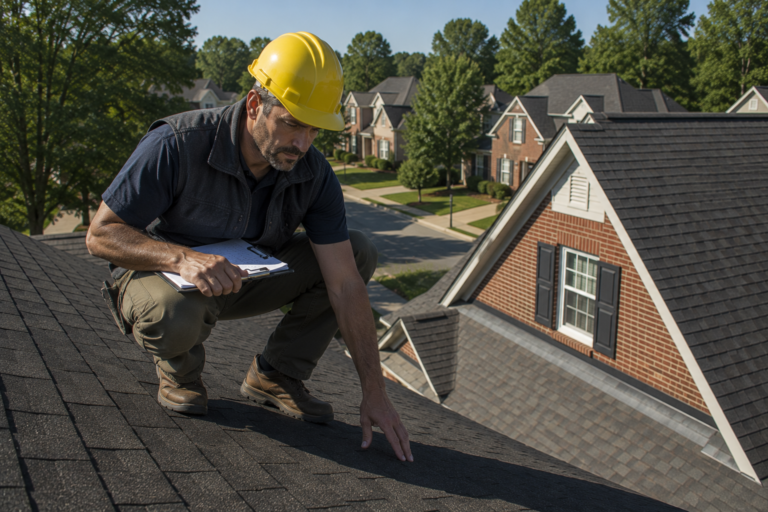
What inspectors find: Missing, cracked, or displaced shingles, shingles showing granule loss from hail strikes (often appearing as bald spots or pockmarks), improper flashing at chimneys, skylights, roof penetrations, or wall-to-roof junctions, deteriorated or incorrectly installed step flashing, gutter systems pulling away from fascia, and flat or low-slope roof sections with standing water or membrane failures.
What it means: A roof with significant hail damage is not just a repair issue — it is potentially an insurance issue. Some carriers will not write a new homeowner’s policy on a home with documented hail damage, or will require a roof replacement as a condition of coverage. Sellers sometimes have insurance claim history that discloses prior storm events; request this documentation as part of your due diligence.
Electrical: Federal Pacific and Zinsco Panels
Homes built or renovated between the 1950s and early 1990s across the Triangle sometimes contain electrical panels made by Federal Pacific Electric (FPE) — whose Stab-Lok breakers are known to fail to trip under overload conditions — or Zinsco panels with a documented history of overheating and arcing. Both are red flags for home inspectors and insurers alike.
What to expect: Inspectors will report the panel brand by name and note that replacement is recommended. Most homeowner’s insurance carriers in NC will not write a policy on a home with a Federal Pacific or Zinsco panel, which makes the issue both a safety concern and a practical closing obstacle.
Cost to address: Panel replacement by a licensed NC electrician typically runs $3,000 to $6,000. Negotiating this as a seller credit or a repair prior to closing is a common outcome when these panels appear in an inspection report.
Other electrical findings: GFCI protection missing in kitchens, bathrooms, garages, and exterior outlets; double-tapped breakers; aluminum branch wiring in homes built in the late 1960s and 1970s; and ungrounded outlets in pre-1960s homes are also commonly flagged findings.
Polybutylene Plumbing: A Triangle-Specific Concern
Polybutylene pipe was widely used in residential plumbing from approximately 1978 to 1995 — right in the sweet spot of a significant portion of the Triangle’s existing housing stock. The material was recalled and stopped being manufactured after evidence of premature failure, and its presence in a home is a material disclosure item in NC.
What to look for: Gray or blue flexible plastic pipe most commonly found at the water meter connection, main shutoff valve, or running through interior walls. If you see flexible gray pipe that is not clearly copper, CPVC, or PEX, ask the inspector to identify it specifically.
What it means: Polybutylene pipe has a documented history of chlorine degradation leading to joint failures and leaks. Insurance carriers increasingly decline to write policies on homes with poly pipe, and some mortgage lenders have restrictions as well. Full replacement costs vary by home size but typically run $10,000 to $20,000 for a slab home and more for a two-story. Crawl space access can reduce the cost in homes where plumbing runs through an accessible crawl space.
Termites and Wood-Destroying Organisms
North Carolina is classified as a high-termite-activity state. A pest inspection — technically called a Wood Destroying Insect (WDI) inspection in NC — is a standard add-on to a general home inspection and is required by most mortgage lenders. It should be ordered as part of every Triangle purchase inspection.
What pest inspectors look for: Active termite activity, termite damage to structural wood members, other wood-destroying insect activity (carpenter ants, carpenter bees, wood-boring beetles), moisture damage that facilitates WDO activity, and conducive conditions like wood-to-soil contact around the foundation.
What findings mean: Active termite activity requires treatment before most lenders will fund the loan. Treatment costs vary by method — liquid soil treatment, baiting systems, fumigation — but are typically $500 to $2,000 for active infestations without major structural damage. Structural damage to framing members is a separate and potentially significant repair. For homes with known or suspected WDO damage, a structural engineer assessment during due diligence is worth the cost.
Grading and Drainage: Water Where It Doesn’t Belong
Many Triangle homes — particularly those on lots with clay soil or in older neighborhoods where grading has settled over time — show drainage patterns that direct surface water toward rather than away from the foundation. This is a contributing factor to crawl space moisture issues and, in severe cases, can affect foundation performance.
What inspectors find: Negative grade (land sloping toward the home within six feet of the foundation), downspout discharge terminating at the foundation rather than being extended away, landscape beds built up against siding creating wood-to-soil contact, and evidence of surface water entry at the foundation perimeter.
What it means: Minor grading and downspout corrections are often DIY-level repairs. More extensive drainage corrections involving swales, French drains, or regrading with fill can run $2,000 to $8,000 or more depending on lot conditions. If crawl space moisture findings and drainage findings appear together in the same report, treat them as a connected system rather than separate items.
For a complete picture of what happens during the due diligence process and how inspection findings fit into your decision, the what happens after your offer is accepted guide walks through the full post-contract timeline step by step. And once you understand your findings, the buyer’s guide to writing a strong offer explains how the due diligence fee and inspection findings interact in the negotiation process.
Frequently Asked Questions
How much does a home inspection cost in Raleigh NC?
A general home inspection in Raleigh typically costs $350 to $550 depending on the size, age, and complexity of the home. Add-on inspections cost extra: radon testing runs $100 to $200, termite/WDI inspections run $65 to $125, and specialty inspections (crawl space, sewer scope, pool, fireplace) each add $250 to $550. Budget $850 to $2,500 for a comprehensive inspection package on a typical Triangle home. These are costs paid by the buyer at the time the service is performed and are non-refundable for any reason.
What happens if an inspection finds a major problem in NC?
In North Carolina, a significant inspection finding does not automatically give you the right to cancel without losing your earnest money — that right exists only during the due diligence period regardless of what the inspector finds. During the due diligence period, you have three options: negotiate a repair or credit with the seller using NC Form 310-T, terminate the contract and receive your earnest money back, or proceed without change. After the due diligence deadline, your option to terminate without penalty is gone. This is why scheduling inspections in the first week of due diligence is critical — it leaves time to negotiate or terminate before the deadline. This is why I stress inspections quickly.
Should I get a radon test in Raleigh NC?
Yes. Wake County is classified as EPA Zone 2 (moderate radon potential), and radon levels in individual homes vary significantly regardless of zone classification — the only way to know whether a specific home has elevated radon is to test it. The test is inexpensive ($100 to $200 through most Triangle home inspectors who offer it as an add-on), and if the result comes back above the EPA action level of 4 picocuries per liter, mitigation is available and costs $1,200 to $3,000 in most cases. Order the radon test along with your general inspection — do not wait or treat it as optional.
What is a Federal Pacific panel and why does it matter?
Federal Pacific Electric (FPE) manufactured electrical panels — sold under the Stab-Lok brand name — that are known to fail to trip under overload conditions. Homes with FPE Stab-Lok panels have a documented higher risk of electrical fire due to this failure mode. Most NC homeowner’s insurance carriers will not write a policy on a home with an FPE panel without requiring replacement. Inspectors will identify the brand and recommend replacement in their reports. Zinsco panels (also called GTE-Sylvania in some cases) have a similar documented failure history. Replacement costs $3,000 to $6,000 and can be negotiated as a seller repair or credit during the due diligence period.
Is polybutylene pipe a dealbreaker when buying a home?
Not necessarily, but it requires a plan. Polybutylene (poly-b) pipe has a documented failure history, and its presence will complicate both insurance and some mortgage programs. Before deciding, get a licensed plumber to assess the current condition of the pipe during due diligence — the age, chlorine exposure history, and visible condition of the fittings all affect how urgent replacement is. Then get a replacement quote. If the cost is manageable and you can negotiate a seller credit or reduced purchase price to reflect it, poly pipe does not have to end the transaction. If the seller refuses to acknowledge the issue in negotiating, that is useful information about what else might have been deferred. I have helped several clients navigate polybutylene piping, including full replacements and just replacing the pipe fittings.
Knowing what to expect from an inspection puts you in a position of strength, not anxiety. Finding issues during due diligence is the system working correctly — it is far better than discovering them after closing. To talk through a specific inspection report, what’s worth negotiating, and what’s worth walking away from, email brandon@theoceanairerealty.com or call or text 910-228-6481.
About Brandon Yopp
Brandon Yopp is a top-producing REALTOR® with The Oceanaire Realty, serving sellers and buyers across Raleigh, Durham, Chapel Hill, Cary, Apex, and the surrounding Triangle communities in North Carolina. A Triangle resident for more than 20 years, Brandon is known for deep local market knowledge, strategic pricing, expert negotiation, and a marketing approach built to give sellers maximum exposure across the platforms today’s buyers actually use. He’s a multi-year Triangle Real Producers Top 500 honoree and a Certified Luxury Home Marketing Specialist™, guiding first-time buyers, upsizers, downsizers, relocating clients, and investors through the Triangle market with confidence. Over 90% of his business comes from repeat clients and referrals.