NC Revenue Stamps: What Is the NC Excise Tax on Home Sales and How Much Will You Pay in Raleigh in 2026?
If you’ve ever looked at a closing disclosure or talked to a real estate attorney about what you’ll pay when you sell, you’ve probably seen a line item called “revenue stamps” or “NC excise tax.” A lot of sellers get frustrated and upset at an additional cost that they were not anticipating.
Fortunately for my sellers, I’ve educated them on exactly what this is up front so that they already know what it is and expect it at closing time.
Here’s the complete picture — what the NC excise tax is, how it’s calculated, who pays it, where the money goes, and how it fits into your overall seller costs.
The History Behind the Name “Revenue Stamps”
The term “revenue stamps” is a holdover from when this tax was literally administered with stamps. When a deed was recorded, a physical stamp was affixed to indicate that the tax had been paid — similar to a postage stamp, but for property conveyances.
NC G.S. Chapter 105, Article 8E governs the excise tax on conveyances. The provision requiring physical stamps was repealed; today, the Register of Deeds uses a meter or electronic notation to mark that the tax was paid. The stamps are gone. The name stuck.
The official name is the “excise tax on conveyances” under NC General Statutes Article 8E (G.S. 105-228.28 through 105-228.37). But if you ask any local real estate attorney or title company, they’ll still call it revenue stamps — and you’ll see it listed that way on your closing documents.
How Is the NC Excise Tax Calculated?
The math is straightforward, but there’s a detail that trips sellers up: the rate applies to each $500 or fraction thereof.
That means if your sale price doesn’t land on an even $500 increment, you round up. Example: a $440,250 sale is calculated as if it were $440,500 (the next full $500 increment). That gives you 881 increments at $1.00 each, or $881 — not $880. In practice, most sales round to even numbers in the negotiations, so fractions are uncommon. But your closing attorney will apply the rounding rule exactly.
Here’s the quick reference table for common Raleigh and Wake County price points:
- $350,000 sale price: $700 in excise tax
- $400,000 sale price: $800
- $440,000 sale price: $880
- $500,000 sale price: $1,000
- $600,000 sale price: $1,200
- $750,000 sale price: $1,500
- $1,000,000 sale price: $2,000
Wake County’s July 2026 median sale price was $440,000 — putting the typical excise tax right around $880 for a median transaction. For buyers and sellers in the higher-end North Raleigh, Inside-The-Beltline, or luxury markets, excise tax on a $900,000 to $1.2M sale runs $1,800 to $2,400.
Who Pays the NC Excise Tax?
The seller pays. Almost always.
Under NC G.S. 105-228.30, the tax is imposed on the transferor — the party conveying the deed. In a standard residential sale, that’s the seller. The closing attorney collects the excise tax from the seller’s proceeds at closing and remits it to the county Register of Deeds when the deed is recorded.
The deed cannot be recorded without payment of the excise tax. No recording means no transfer of title to the buyer. For this reason, there’s no practical way to skip it.
Is it negotiable? Technically, the statute imposes the tax on the transferor and doesn’t prevent parties from agreeing that the buyer covers it. In practice, it’s nearly always a seller cost in NC transactions. Don’t expect a buyer to agree to pay it without offering something in return — and if your listing is competitive, buyers won’t volunteer.
The only exception I’ve ever seen to this is in new construction, where the builder almost never pays. Buyers are on the hook there almost universally. So if you’re selling a place and also buying new construction at roughly the same time, you are almost certain to be on the hook for excise tax on both transactions.
If you want to understand how excise tax fits into your complete seller cost picture, my guide to how much Triangle sellers net after closing walks through every line item.
Where Does the Money Go?
The excise tax proceeds are split. Per NC G.S. 105-228.37:
- 50% goes to the county’s general fund (in Wake County, that’s Wake County government)
- 50% is remitted to the State of North Carolina, where the county may retain up to 2% for administrative costs. The remaining 48% is deposited into state trust funds — 75% to the Parks and Recreation Trust Fund and 25% to the Natural Heritage Trust Fund.
In other words: when you sell your Raleigh home and pay revenue stamps, roughly half supports local county operations and the other half funds state parks, recreation infrastructure, and natural resource preservation. Most sellers don’t know this — and it reframes the excise tax slightly. It directly funds the greenways, parks, and natural spaces that make the Triangle attractive and support property values over time.
When Does It Show Up on Your Closing Documents?
The excise tax appears twice in your closing transaction.
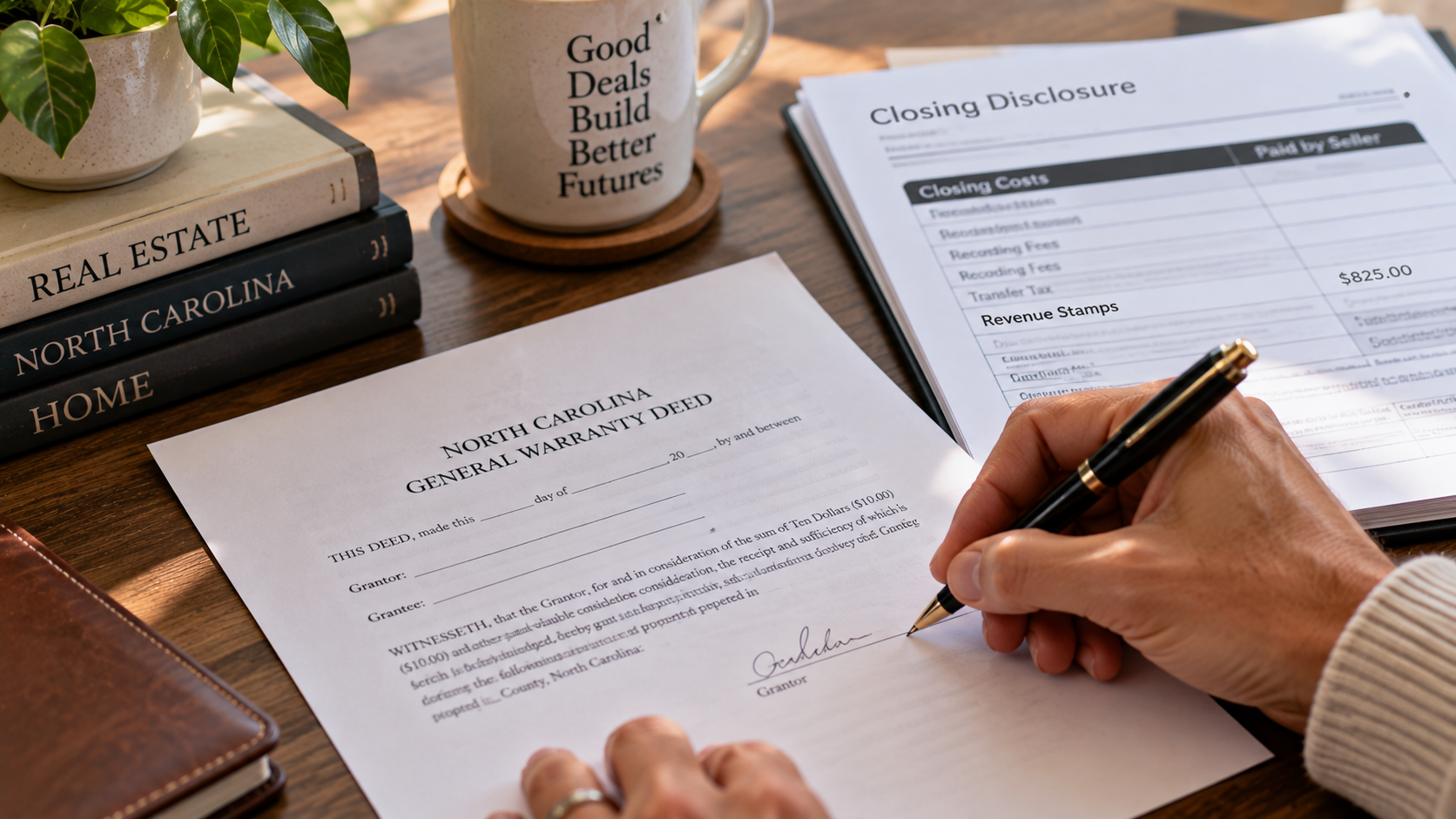
On the closing disclosure. It’s listed in the seller’s column under closing costs or fees. Your closing attorney will calculate the exact amount based on the agreed sale price before closing day.
On the deed. The Register of Deeds marks the deed to indicate the excise tax paid and the amount. This notation is part of the public record.
For a full breakdown of what else appears on the seller’s closing disclosure, read my guide to what to expect at closing as a seller in Raleigh NC.
How Excise Tax Fits Into Your Total Seller Costs
Revenue stamps are one of the smaller seller closing costs — but they’re also one of the most certain. Unlike agent commission (negotiable) or seller concessions (situational), the excise tax is fixed by statute. You will pay it, and the amount is deterministic once you know the sale price.
To put it in context: on a $500,000 sale in Wake County, total seller closing costs typically run $45,000 to $55,000 (covering agent commissions, attorney fees, prorated taxes, and miscellaneous fees). The $1,000 excise tax is roughly 2% of that total.
Other fixed seller costs at closing include the seller’s attorney fee ($800 to $1,200 typically), recording fees ($50 to $150), and property tax proration. Costs that vary include agent commission, seller concessions, and outstanding liens or HOA fees.
For a detailed look at what sellers offer buyers to help close a deal, read my guide to seller concessions in Raleigh NC 2026. And if you’re pricing your home and want to work backward from your target net, my pricing guide for Raleigh sellers shows you how to run that math.
Frequently Asked Questions
What is the NC excise tax rate on home sales?
The NC excise tax on real estate conveyances is $1.00 per $500 of the sale price, or any fraction thereof — effectively $2 per $1,000 of sale price. On a $450,000 sale, the tax is $900. On a $750,000 sale, it’s $1,500. The rate is set by state statute (G.S. 105-228.30) and applies to all deed conveyances in North Carolina.
Does the buyer or seller pay revenue stamps in NC?
In North Carolina, the seller pays the excise tax (revenue stamps) at closing. The tax is legally imposed on the transferor — the party conveying the deed — which is the seller. While it’s technically negotiable between parties, it’s nearly always a seller cost in standard NC residential transactions. One caveat to this is that the buyer should expect to pay the excise tax on new construction and not the builder/seller.
Do I have to pay excise tax if I’m selling my home at a loss?
Yes. The NC excise tax is calculated on the actual sale price (the consideration in the deed), not on your profit or equity. If you sell for $300,000 on a home you paid $320,000 for, you still owe $600 in excise tax. The tax is imposed on the conveyance, not the gain.
What does the excise tax appear as on the closing disclosure?
On the seller’s closing disclosure, it appears as “Revenue Stamps,” “NC Excise Tax,” or “NC Excise Tax on Conveyance.” Your closing attorney or title company will label it based on their software, but the line item is always present and calculated automatically from the sale price.
What if I’m selling a home that transferred through inheritance or as a gift?
Excise tax applies to conveyances for consideration — meaning sales where money changes hands. Gifts and inheritances that transfer with no consideration generally are not subject to excise tax, but these transactions are documented differently (affidavit of consideration). Your closing attorney will advise on the appropriate treatment for your specific situation.
Excise tax is one of the line items that surprises sellers until they’ve seen a closing disclosure before — and then it becomes just another calculation. The bigger surprise is usually the combination of all the smaller costs that add up alongside commission. If you’re thinking through your own sale and want to run the real numbers on what you’d net, let’s talk.
The best next step is a quick, confidential conversation. Email me at brandon@theoceanairerealty.com or call or text 910-228-6481 and we’ll run through your situation, your goals, and what a sale would actually put in your pocket.
About Brandon Yopp
Brandon Yopp is a top-producing REALTOR® with The Oceanaire Realty, serving sellers and buyers across Raleigh, Durham, Chapel Hill, Cary, Apex, and the surrounding Triangle communities in North Carolina. A Triangle resident for more than 20 years, Brandon is known for deep local market knowledge, strategic pricing, expert negotiation, and a marketing approach built to give sellers maximum exposure across the platforms today’s buyers actually use. He’s a multi-year Triangle Real Producers Top 500 honoree and a Certified Luxury Home Marketing Specialist™, guiding first-time buyers, upsizers, downsizers, relocating clients, and investors through the Triangle market with confidence. Over 90% of his business comes from repeat clients and referrals.