Wake County Real Estate Market Update: October 2026
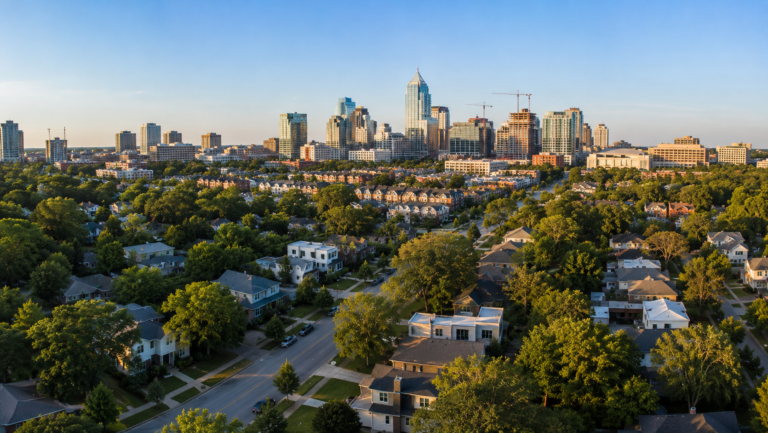
According to the Wake County Register of Deeds, the median sales price of Wake County real estate in October 2026 was $475,000, an increase of $25,000 from September’s $450,000. That is the largest single-month median increase recorded in Wake County in 2026 and brings the median back to its June 2026 high. Total transaction volume reached $1.4 billion across 5,485 recorded transactions, a decrease of 484 from September.
A note on what the median measures: the Wake County Register of Deeds consistently notes that median values are anchored to core market activity. In October, 88% of all recorded transactions occurred in the core market segment, properties valued at $1 million or less. The three large transactions in the very high-value tier this month, totaling $241 million, are too few in number to shift the median in either direction. The $475,000 reading reflects what buyers and sellers in the active residential market are actually experiencing.
The $25,000 jump deserves context. After the median softened from $475,000 in June to $458,500 in July and $440,000 in August before recovering to $450,000 in September, October’s reading completes a four-month recovery arc. The median is not simply rebounding on momentum. It reflects the composition of what closed in October. When a higher proportion of core market closings cluster in the $500,000 to $800,000 range rather than at the lower end of the core segment, the median rises even if total volume declines. October’s data suggests that is what happened: a smaller pool of buyers, but one weighted toward higher-priced core market transactions.
Core Market Activity: 5,278 Transactions as October Closes the Fall Window
The core market, properties valued at $1 million or less, recorded 5,278 transactions in October, a decrease of 492 transactions (8.5%) from September’s 5,770. This segment covers the majority of homebuyers and sellers in Raleigh, Cary, Apex, Durham, Chapel Hill, Wake Forest, and the surrounding Triangle communities.
An 8.5% month-over-month decline in core market volume is steeper than September’s 3.1% decline and reflects the seasonal pattern for October. Fall buying activity in the Triangle peaks in September as buyers who entered the market after Labor Day push to close before the holiday season. By October, that urgency fades. Buyers who have not found a home often pause until spring. Sellers who listed in late summer and have not closed are facing a decision about whether to stay on through winter or pull back and re-enter in March.
For sellers currently on the market, the October volume data makes the case for reviewing your position clearly. The buyers who are active in October and November are serious. They are not window-shopping. But there are fewer of them, and they are doing more research than the same buyers would have done in spring. A well-priced, well-prepared home in Raleigh, Cary, or Apex is still selling. What the data tells you is that the margin for error is smaller now than it was in August. If your home has been sitting for two weeks or more without meaningful activity, the two-week checkpoint for price reduction decisions applies as directly in November as it did in September.
For buyers, the reduced volume means less competition. October and November are historically the period when buyers find the most room to negotiate in the Triangle market. Sellers who have been on the market through the fall are more likely to accept concessions or pricing adjustments than a seller who listed two weeks ago in a hot spring market. If you have been pre-approved and have been watching a home sit, October’s volume data suggests the conditions favor making a move.
One broader point for sellers evaluating offers this fall: the seller’s net sheet is the right tool for understanding what a given offer actually means to your bottom line after commissions, NC excise tax, attorney fees, and any agreed concessions. When fewer buyers are competing and you are weighing one or two offers rather than five, knowing your exact net from each scenario matters more than it does in a multiple-offer situation.
Senior Living at Scale: October’s Very High-Value Segment Tells a Demographic Story
The high-value segment, transactions between $1 million and $30 million, recorded 204 transactions in October totaling $448.0 million, a decrease of $95.1 million from September’s $543.1 million. Month-over-month variation at this tier is routine given the small transaction pool and deal-timing dynamics.
The more significant story in October sits in the very high-value tier. Wake County recorded 3 transactions each exceeding $30 million, totaling $241 million:
- Cambridge Village of Apex: $110 million
- Cambridge Village of Briar Creek, Raleigh: $99 million
- Midtown Crossing Apartments, Raleigh: $32 million
Two of the three transactions are senior living communities: Cambridge Village of Apex and Cambridge Village of Briar Creek in northeast Raleigh. Combined, they represent $209 million in a single month. That is not a coincidence of timing. It is a signal about where institutional capital sees demand heading.
Senior and active adult communities across Wake County have been a growing part of the residential real estate conversation for the better part of a decade. Wake County’s population growth has not been limited to families and young professionals. The demographic that relocated to Raleigh and the Triangle in their 30s and 40s during the technology and research expansion of the 1990s and 2000s is now approaching and entering retirement age. Institutional buyers of senior living communities are underwriting that demographic wave at the county level.
An acquisition at $110 million or $99 million is not speculative. Investors buying stabilized senior communities at that price point are underwriting existing occupancy, cash flow from monthly fees, and the population trajectory supporting future demand. That two transactions of this type closed in October in Wake County, one in Apex and one in Briar Creek, is a significant data point about how institutional capital views the long-term demand profile for this market.
The third very high-value transaction, Midtown Crossing Apartments in Raleigh at $32 million, continues the multifamily apartment acquisition trend that has been visible in Wake County’s very high-value tier throughout 2026. Together, all three transactions reinforce the pattern that has characterized the year: large-scale capital continuing to enter Wake County across multiple residential asset types.
None of these transactions affect the median sales price calculation. But the institutional confidence they represent is relevant context for anyone asking whether Wake County real estate remains a sound long-term position.
Lending Activity: Deed of Trust Volume Declines with Purchase Moderation
Real estate lending activity in October produced 2,585 deed of trust recordings, down 325 from September’s 2,910.
In North Carolina, a deed of trust secures a real property loan. Every new purchase mortgage generates a deed of trust recording. Every refinancing transaction does as well. The 325-transaction decline from September is steeper than the month prior’s 88-transaction decline, and it closely tracks the 492-transaction drop in core market activity. That parallel suggests the lending decline reflects fewer new purchase mortgages rather than a separate pullback in refinancing demand.
The ratio relationship between deeds of trust and deed volume is a useful secondary indicator. When deeds of trust decline proportionally with deeds, the market is experiencing fewer transactions overall. When deeds of trust decline more sharply than deeds, it suggests refinancing demand is also falling. October’s pattern is consistent with the former: fewer purchases, lending following proportionally.
For buyers evaluating their timeline, the October lending data does not indicate tightening credit conditions. It reflects reduced transaction volume. If you are pre-approved and ready to move, the lending environment is functioning normally.
What This Means If You Are Buying or Selling in Raleigh Right Now
For sellers, October’s $25,000 median jump to $475,000 is meaningful context, but it does not change the ground-level dynamics you are navigating. Fewer buyers are actively searching in November than were searching in September. The buyers who are active have done more research, are comparison-shopping more carefully, and are making decisions more deliberately. The NC Property Tax Amendment and Raleigh Housing Bond that passed in November are relevant background for buyers evaluating long-term cost of ownership, but they do not change the near-term supply and demand balance you are facing as a seller.
The homes capturing strong outcomes right now have three things in common: accurate pricing from day one, strong condition and presentation, and a seller who understands what their net looks like before they evaluate any offer. If your home is priced at a level that made sense when you listed but has not produced the offer activity you expected, reviewing your positioning before the holiday season sets in is worth doing now rather than waiting until January.
For buyers, the fall data favors you. The median at $475,000 reflects what the market is doing overall, but that number does not tell you what any specific home in any specific neighborhood is worth right now. In segments above $600,000, where days on market have been elevated throughout 2026, there are well-priced homes that have been on the market long enough that the sellers are genuinely ready to negotiate. In the core market, the reduced competition means fewer multiple-offer situations and more room to ask for repairs, credits, or pricing adjustments.
The Cambridge Village institutional transactions are worth noting from a buyer perspective as well. The active adult segment in Wake County is not being overlooked. If you or a family member are thinking about active adult or senior living options in Wake County, the fact that institutional capital is investing at this scale suggests long-term confidence in this segment’s viability across both Apex and Raleigh submarkets.
October’s $1.4 billion in total transaction value, achieved with fewer transactions than September, underscores that Wake County continues to record significant real estate activity at scale. The very high-value transactions are driving a larger share of the total dollar volume than in prior months, but the core residential market remains active. The fundamentals have not changed.
Frequently Asked Questions
What was the median home price in Wake County in October 2026?
The median sales price of Wake County real estate in October 2026 was $475,000, according to the Wake County Register of Deeds. That is an increase of $25,000 from September 2026’s $450,000 and the largest single-month median increase recorded in Wake County in 2026. The median is driven by the core market segment, properties valued at $1 million or less, which accounted for 88% of all October transactions. The three very high-value transactions totaling $241 million had no material effect on the median calculation.
How many home sales were recorded in Wake County in October 2026?
The core market, properties valued at $1 million or less, recorded 5,278 transactions in October, a decrease of 492 (8.5%) from September’s 5,770. The high-value segment, transactions between $1 million and $30 million, added 204 transactions totaling $448.0 million. Three transactions in the very high-value tier combined for $241 million. Total transactions across all segments were 5,485, down 484 from September, and total sales value reached $1.4 billion.
What were the largest real estate transactions in Wake County in October 2026?
The three largest transactions in Wake County in October 2026 were two senior living communities and a multifamily apartment complex. Cambridge Village of Apex closed at $110 million and Cambridge Village of Briar Creek in Raleigh closed at $99 million, together representing $209 million in senior living investment. Midtown Crossing Apartments in Raleigh closed at $32 million. The two Cambridge Village acquisitions reflect institutional capital underwriting long-term senior housing demand in Wake County’s growing older adult population.
What does the core market decline mean for Wake County sellers?
The 8.5% month-over-month decline in core market volume is consistent with normal fall seasonality. The buyers who closed in October entered the market in August and September, and new buyer activity typically slows from October through December compared to the spring and summer peak. Fewer active buyers means less competition for well-priced homes, but it also means less tolerance for overpricing. Homes that are priced accurately and presented well continue to sell; homes with pricing gaps that buyers overlooked in spring are receiving more scrutiny now.
What does October’s deed of trust data tell us about the Wake County lending environment?
Wake County recorded 2,585 deed of trust transactions in October, down 325 from September’s 2,910. The decline closely tracks the drop in core market transaction volume, which suggests fewer new purchase mortgages are driving the reduction rather than a separate contraction in refinancing demand. The lending environment appears to be following purchase activity in proportion, consistent with seasonal volume moderation rather than any tightening of credit conditions or change in buyer financing behavior.
The October 2026 data from the Wake County Register of Deeds shows a market with a recovering and strengthening median, expected seasonal volume moderation in the core market, and two of the largest senior living transactions ever recorded in a single month in Wake County. The fundamentals that have made Wake County a strong long-term real estate market remain in place.
If you are thinking about buying or selling in Raleigh, Durham, Cary, Apex, Chapel Hill, or Wake Forest this fall and want to talk through what the data means for your specific situation, email brandon@theoceanairerealty.com or call or text 910-228-6481 for a confidential consultation.
About Brandon Yopp
Brandon Yopp is a top-producing REALTOR® with The Oceanaire Realty, serving sellers and buyers across Raleigh, Durham, Chapel Hill, Cary, Apex, and the surrounding Triangle communities in North Carolina. A Triangle resident for more than 20 years, Brandon is known for deep local market knowledge, strategic pricing, expert negotiation, and a marketing approach built to give sellers maximum exposure across the platforms today’s buyers actually use. He’s a multi-year Triangle Real Producers Top 500 honoree and a Certified Luxury Home Marketing Specialist™, guiding first-time buyers, upsizers, downsizers, relocating clients, and investors through the Triangle market with confidence. Over 90% of his business comes from repeat clients and referrals.